Science
The Value of Science 豆瓣
作者: Henri Poincare 出版社: Modern Library 2001 - 10
More than any other writer of the twentieth century, Henri Poincaré brought the elegant, but often complicated, ideas about science and mathematics to the general reader. A genius who throughout his life solved complex mathematical calculations in his head, and a writer gifted with an inimitable style, Poincaré rose to the challenge of interpreting the philosophy of science to scientists and nonscientists alike. His lucid and welcoming prose made him the Carl Sagan of his time. This volume collects his three most important books: Science and Hypothesis (1903); The Value of Science (1905); and Science and Method (1908).
Astrology and Cosmology in Early China 豆瓣
作者: David W. Pankenier 出版社: Cambridge University Press 2013 - 11
http://www.cambridge.org/us/academic/subjects/history/east-asian-history/astrology-and-cosmology-early-china-conforming-earth-heaven
The ancient Chinese were profoundly influenced by the Sun, Moon and stars, making persistent efforts to mirror astral phenomena in shaping their civilization. In this pioneering text, David W. Pankenier introduces readers to a seriously understudied field, illustrating how astronomy shaped the culture of China from the very beginning and how it influenced areas as disparate as art, architecture, calendrical science, myth, technology, and political and military decision-making. As elsewhere in the ancient world, there was no positive distinction between astronomy and astrology in ancient China, and so astrology, or more precisely, astral omenology, is a principal focus of the book. Drawing on a broad range of sources, including archaeological discoveries, classical texts, inscriptions and paleography, this thought-provoking book documents the role of astronomical phenomena in the development of the 'Celestial Empire' from the late Neolithic through the late imperial period.
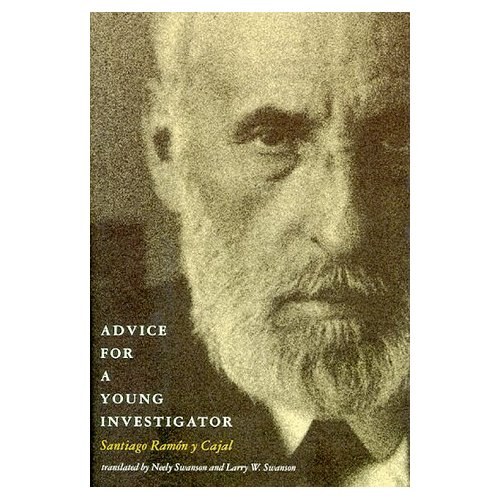
Advice for a Young Investigator 豆瓣
作者: Santiago Ramón y Cajal 译者: Larry W. Swanson 出版社: A Bradford Book 1999 - 2
Santiago Ramon y Cajal was a mythic figure in science. Hailed as the father of modern anatomy and neurobiology, he was largely responsible for the modern conception of the brain. His groundbreaking works were New Ideas on the Structure of the Nervous System and Histology of the Nervous System in Man and Vertebrates. In addition to leaving a legacy of unparalleled scientific research, Cajal sought to educate the novice scientist about how science was done and how he thought it should be done. This recently rediscovered classic, first published in 1897, is an anecdotal guide for the perplexed new investigator as well as a refreshing resource for the old pro.
Cajal was a pragmatist, aware of the pitfalls of being too idealistic -- and he had a sense of humor, particularly evident in his diagnoses of various stereotypes of eccentric scientists. The book covers everything from valuable personality traits for an investigator to social factors conducive to scientific work.
--from amazon
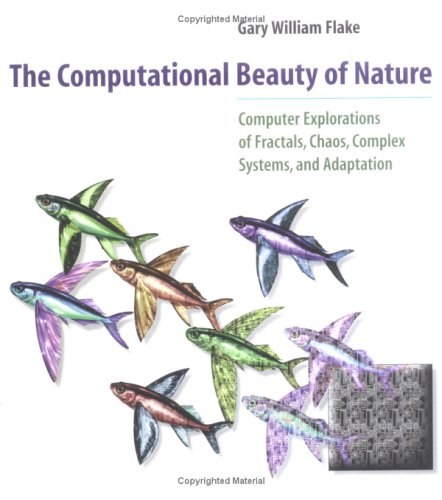
The Computational Beauty of Nature 豆瓣
作者: Gary William Flake 出版社: The MIT Press 2000 - 1
"Simulation," writes Gary Flake in his preface, "becomes a form of experimentation in a universe of theories. The primary purpose of this book is to celebrate this fact."In this book, Gary William Flake develops in depth the simple idea that recurrent rules can produce rich and complicated behaviors. Distinguishing "agents" (e.g., molecules, cells, animals, and species) from their interactions (e.g., chemical reactions, immune system responses, sexual reproduction, and evolution), Flake argues that it is the computational properties of interactions that account for much of what we think of as "beautiful" and "interesting." From this basic thesis, Flake explores what he considers to be today's four most interesting computational topics: fractals, chaos, complex systems, and adaptation.Each of the book's parts can be read independently, enabling even the casual reader to understand and work with the basic equations and programs. Yet the parts are bound together by the theme of the computer as a laboratory and a metaphor for understanding the universe. The inspired reader will experiment further with the ideas presented to create fractal landscapes, chaotic systems, artificial life forms, genetic algorithms, and artificial neural networks.
A Social History of Truth 豆瓣
作者: Steven Shapin 出版社: University of Chicago Press 1995 - 11
How do we come to trust our knowledge of the world? What are the means by which we distinguish true from false accounts? Why do we credit one observational statement over another? This study engages these universal questions through a recreation of a crucial period in the history of early modern science: the social world of gentlemen-philosophers in 17th-century England. The author paints a picture of the relations between gentlemanly culture and scientific practice. He argues that problems of credibility in science were practically solved through the codes and conventions of genteel conduct: trust, civility, honour, and integrity. These codes formed, and arguably still form, an important basis for securing reliable knowledge about the natural world. Shapin uses detailed historical narrative to argue about the establishment of factual knowledge both in science and in everyday practice. Accounts of the mores and manners of gentlemen-philosophers are used to illustrate Shapin's broad claim that trust is imperative for constituting every kind of knowledge. Knowledge-making is always a collective enterprise: people have to know whom to trust in order to know something about the natural world.
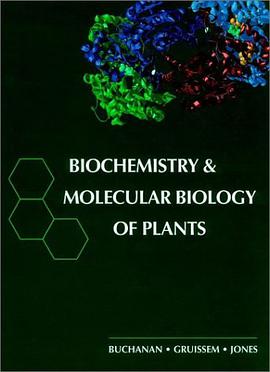
Biochemistry & Molecular Biology of Plants 豆瓣
作者: Buchanan, Bob B. (EDT)/ Gruissem, Wilhelm/ Jones, Russell L. 出版社: Wiley 2002 - 5
Biochemistry Molecular Biology of Plants is a major contribution to the plant sciences literature, superbly edited by three distinguished scientists, Bob B. Buchanan, Wilhelm Gruissem, and Russell L. Jones, with contributions from more than 50 world-renowned scientists. With over 1,400 pages, 1,100 full-colour original drawings and 500 photographs this work qualifies, in the words of the Science reviewer, as:
"an essential reference for practicing plant biologists and for the increasing number of scientists from other disciplines who are entering the field of plant biology. To exploit fully the wealth of new information provided by the genome projects and to integrate the metabolic, regulatory, and signal transduction pathways of complex organisms, biologists will require a solid command of biochemistry and physiology. For this reason, the publication of Biochemistry Molecular Biology of Plants could not have come at a more opportune and auspicious time."
This book is meticulously organised and richly illustrated, useful both for teaching and for reference. The multi-authored work provides a contemporary view of its subject, including molecular biology, cell biology, and plant physiology, integrated around the themes of:


compartmentation
cell reproduction
energetics
metabolism
development Read the words of the reviewer in CELL:
"The great strength of this book is that it has integrated its three major components (molecular biology, cell biology, and plant biochemistry) in each of the 24 chapters, resulting in a comprehensive analysis of a multitude of specific topics."
Who should buy this spectacular new text?
Plant biologists and scientists in related fields
Professors in departments of plant biology, plant biochemistry, plant physiology, and related fields
Graduate and upper-level undergraduate students of plant biology
Researchers in the pharmaceutical, biotechnology, and agribusiness industries
A CD-ROM of all illustrative matter in the book is available separately.
发育原理 豆瓣
作者: 沃尔珀特Wolpert, Lewis 译者: 周荣家 / 赵彦修 出版社: 高等教育出版社 2009 - 4
《发育原理》(第2版)简明扼要,概括性强,每章用不长的篇幅既系统阐述了发育原理又重点介绍了必要概念;选用了大量图解配合有关章节内容形象地解释发育原理和重要概念,并精心撰写了各章节的小结附于其后,对主要内容的展示起到了画龙点睛的作用;在编排体系上,内容衔接逻辑性强,因而易于讲授与学习;书后附有重要的术语,便于诀者对这些关键性概念的检索和理解。
The Mind Doesn't Work That Way 豆瓣
作者: Jerry Fodor 出版社: The MIT Press 2001 - 9
In this engaging book, Jerry Fodor argues against the widely held view that mental processes are largely computations, that the architecture of cognition is massively modular, and that the explanation of our innate mental structure is basically Darwinian. Although Fodor has praised the computational theory of mind as the best theory of cognition that we have got, he considers it to be only a fragment of the truth. In fact, he claims, cognitive scientists do not really know much yet about how the mind works (the book's title refers to Steve Pinker's How the Mind Works).Fodor's primary aim is to explore the relationship among computational and modular theories of mind, nativism, and evolutionary psychology. Along the way, he explains how Chomsky's version of nativism differs from that of the widely received New Synthesis approach. He concludes that although we have no grounds to suppose that most of the mind is modular, we have no idea how nonmodular cognition could work. Thus, according to Fodor, cognitive science has hardly gotten started.
Wrestling with Nature 豆瓣
作者: Peter Harrison (EDT) / Ronald L. Numbers (EDT) 出版社: University Of Chicago Press 2011 - 6
When and where did science begin? Historians have offered different answers to these questions, some pointing to Babylonian observational astronomy, some to the speculations of natural philosophers of ancient Greece. Others have opted for early modern Europe, which saw the triumph of Copernicanism and the birth of experimental science, while yet another view is that the appearance of science was postponed until the nineteenth century. Rather than posit a modern definition of science and search for evidence of it in the past, the contributors to "Wrestling with Nature" examine how students of nature themselves, in various cultures and periods of history, have understood and represented their work. The aim of each chapter is to explain the content, goals, methods, practices, and institutions associated with the investigation of nature and to articulate the strengths, limitations, and boundaries of these efforts from the perspective of the researchers themselves. With contributions from experts representing different historical periods and different disciplinary specializations, this volume offers a fresh perspective on the history of science and on what it meant, in other times and places, to wrestle with nature.
The Book of Why Goodreads 豆瓣
6.8 (10 个评分) 作者: Judea Pearl / Dana Mackenzie 出版社: Basic Books 2018 - 5
A Turing Award-winning computer scientist and statistician shows how understanding causality has revolutionized science and will revolutionize artificial intelligence
“Correlation is not causation.” This mantra, chanted by scientists for more than a century, has led to a virtual prohibition on causal talk. Today, that taboo is dead. The causal revolution, instigated by Judea Pearl and his colleagues, has cut through a century of confusion and established causality–the study of cause and effect–on a firm scientific basis. His work explains how we can know easy things, like whether it was rain or a sprinkler that made a sidewalk wet; and how to answer hard questions, like whether a drug cured an illness. Pearl’s work enables us to know not just whether one thing causes another: it lets us explore the world that is and the worlds that could have been. It shows us the essence of human thought and key to artificial intelligence. Anyone who wants to understand either needs The Book of Why.
叩响天堂之门 豆瓣
Knocking on Heaven's Door:How Physics and Scientific Thinking Illuminate the Universe and the Modern World
作者: [美] 丽莎·兰道尔 译者: 杨洁 / 符玥 出版社: 浙江人民出版社 2016
 人类对宇宙的探索经历了怎样艰辛的历程?宇宙是如何起源的?
 耗资巨额建造的史上最大型的科学仪器——大型强子对撞机(LHC),经历了怎样的曲曲折折?“上帝粒子”以及更多其他物质新组分的发现,将如何颠覆人类目前对物质世界的认知?
 科学研究的本质是什么?科学求索的艰辛与惊喜又体现在何处?
 《叩响天堂之门》语言通俗易懂、案例妙趣横生,不是聚焦于高深晦涩的术语解释,而是对科学求索的真相与未来娓娓道来,是普通读者了解物质世界的最佳科普图书之一。
The Fractal Geometry of Nature 豆瓣
作者: Benoit B. Mandelbrot 出版社: W. H. Freeman and Company 1982
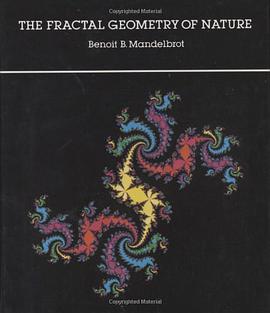
"...a blend of erudition (fascinating and sometimes obscure historical minutiae abound), popularization (mathematical rigor is relegated to appendices) and exposition (the reader need have little knowledge of the fields involved) ...and the illustrations include many superb examples of computer graphics that are works of art in their own right." Nature
近代科学在中国的传播(上下册) 豆瓣
作者: 王扬宗 编校 出版社: 山东教育出版社 2009 - 10
近代科学在清末民初的输入和传播是中国近现代科学发展史上的重大关节之一。本书从浩瀚的清末民初科学文献中,编选若干重要资料。全书包括五个部分:一、译著,二、译著序跋、凡例,三、论说,四、人物、机构、纪事、诗歌,五、书目、提要、读书指南。本书所选资料大多形成于1849至1916年,其中包括《天文论略》、《格物穷理问答》、《博物新编》、《物竞篇》、《天择篇》、《日本调查算学记》、《益智书会书目》、《初学读书要略》、《东西学书录》和120余篇译著序跋例言等。编者对这些资料进行了校勘、标点和整理。可供对中国近代科学史、文化交流史、翻译史、思想史等有兴趣的读者和研究者参考。
A New Kind of Science 豆瓣 谷歌图书 Goodreads
A New Kind of Science
作者: Stephen Wolfram 出版社: Wolfram Media Inc 2002 - 5
Physics and computer science genius Stephen Wolfram, whose Mathematica computer language launched a multimillion-dollar company, now sets his sights on a more daunting goal: understanding the universe. Wolfram lets the world see his work in
, a gorgeous, 1,280-page tome more than a decade in the making. With patience, insight, and self-confidence to spare, Wolfram outlines a fundamental new way of modeling complex systems.
再创世纪 豆瓣
作者: 〔美〕乔治·丘奇(George Church) / 〔美〕艾德·里吉西(Ed Regis) 译者: 周东 出版社: 译言·东西文库/电子工业出版社 2017 - 1
1978年,诺贝尔医学奖颁给发现DNA限制酶的纳森斯(Daniel Nathans)、亚伯(Werner Arber)与史密斯(Hamilton Smith)时,斯吉巴尔斯基在《基因》期刊中写道:限制酶将带领我们进入合成生物学的新时代。转基因技术如今日渐走近大众的视野,大自然创造了我们的世界,人类是否在扮演上帝的角色在进行着再创世纪?合成生物学很大程度上是一门关于如何开发和应用基本工程原理的学科——也就是把象牙塔里那些学术的、纯粹的、甚至是自娱自乐或者抽象的东西,转变成能够对社会带来影响甚至变革的实际事物。世界上第一个所谓人工合成生命体(克雷格·凡特的丝状支原体)的遗传代码中加入了一小段人类文本,其中的一条是:“To live, to err, to fall, to triumph, to recreate life out of life”(去生活、去犯错、去失败、去胜利,去用生命重新创造生命)。
Behave 豆瓣 Goodreads
作者: Robert M. Sapolsky 出版社: Penguin Press 2017 - 5
Why do we do the things we do?
More than a decade in the making, this game-changing book is Robert Sapolsky’s genre-shattering attempt to answer that question as fully as perhaps only he could, looking at it from every angle. Sapolsky’s storytelling concept is delightful but it also has a powerful intrinsic logic: he starts by looking at the factors that bear on a person’s reaction in the precise moment a behavior occurs, and then hops back in time from there, in stages, ultimately ending up at the deep history of our species and its evolutionary legacy.
And so the first category of explanation is the neurobiological one. A behavior occurs–whether an example of humans at our best, worst, or somewhere in between. What went on in a person’s brain a second before the behavior happened? Then Sapolsky pulls out to a slightly larger field of vision, a little earlier in time: What sight, sound, or smell caused the nervous system to produce that behavior? And then, what hormones acted hours to days earlier to change how responsive that individual is to the stimuli that triggered the nervous system? By now he has increased our field of vision so that we are thinking about neurobiology and the sensory world of our environment and endocrinology in trying to explain what happened.
Sapolsky keeps going: How was that behavior influenced by structural changes in the nervous system over the preceding months, by that person’s adolescence, childhood, fetal life, and then back to his or her genetic makeup? Finally, he expands the view to encompass factors larger than one individual. How did culture shape that individual’s group, what ecological factors millennia old formed that culture? And on and on, back to evolutionary factors millions of years old.
The result is one of the most dazzling tours d’horizon of the science of human behavior ever attempted, a majestic synthesis that harvests cutting-edge research across a range of disciplines to provide a subtle and nuanced perspective on why we ultimately do the things we do…for good and for ill. Sapolsky builds on this understanding to wrestle with some of our deepest and thorniest questions relating to tribalism and xenophobia, hierarchy and competition, morality and free will, and war and peace. Wise, humane, often very funny, Behave is a towering achievement, powerfully humanizing, and downright heroic in its own right.
Enlightenment Now 豆瓣
作者: Steven Pinker 出版社: Viking 2018 - 2
The follow-up to Pinker’s groundbreaking The Better Angels of Our Nature presents the big picture of human progress: people are living longer, healthier, freer, and happier lives, and while our problems are formidable, the solutions lie in the Enlightenment ideal of using reason and science.
Is the world really falling apart? Is the ideal of progress obsolete? In this elegant assessment of the human condition in the third millennium, cognitive scientist and public intellectual Steven Pinker urges us to step back from the gory headlines and prophecies of doom, which play to our psychological biases. Instead, follow the data: In seventy-five jaw-dropping graphs, Pinker shows that life, health, prosperity, safety, peace, knowledge, and happiness are on the rise, not just in the West, but worldwide. This progress is not the result of some cosmic force. It is a gift of the Enlightenment: the conviction that reason and science can enhance human flourishing.
Far from being a naïve hope, the Enlightenment, we now know, has worked. But more than ever, it needs a vigorous defense. The Enlightenment project swims against currents of human nature–tribalism, authoritarianism, demonization, magical thinking–which demagogues are all too willing to exploit. Many commentators, committed to political, religious, or romantic ideologies, fight a rearguard action against it. The result is a corrosive fatalism and a willingness to wreck the precious institutions of liberal democracy and global cooperation.
With intellectual depth and literary flair, Enlightenment Now makes the case for reason, science, and humanism: the ideals we need to confront our problems and continue our progress.
Image and Logic 豆瓣
作者: Peter Galison 出版社: University Of Chicago Press 1997 - 10
This study engages with the impact of modern technology on experimental physicists. It reveals how the ever-increasing scale and complexity of apparatus has distanced physicists from the very science which drew them into experimenting, and has fragmented microphysics into different technical traditions. At the beginning of this century, physics was usually done by a lone researcher who put together experimental apparatus on a benchtop. Now experiments are frequently larger than a city block, and experimental physicists lead very different lives - programming computers, working with industry, co-ordinating vast teams of scientists and engineers, and playing politics. The author describes how, as a result of these changes, the necessity for teamwork in operating multimillion-dollar machines has created dynamic "trading zones", where instrument makers, theorists and experimentalists meet, share knowledge, and co-ordinate the extraordinarily diverse pieces of the culture of modern microphysics - work, machines, evidence and argument.
Colonial Botany 豆瓣
作者: Londa Schiebinger / Claudia Swan 出版社: University of Pennsylvania Press 2007 - 7
In the early modern world, botany was big science and big business, critical to Europe's national and trade ambitions. Tracing the dynamic relationships among plants, peoples, states, and economies over the course of three centuries, this collection of essays offers a lively challenge to a historiography that has emphasized the rise of modern botany as a story of taxonomies and "pure" systems of classification. Charting a new map of botany along colonial coordinates, reaching from Europe to the New World, India, Asia, and other points on the globe, Colonial Botany explores how the study, naming, cultivation, and marketing of rare and beautiful plants resulted from and shaped European voyages, conquests, global trade, and scientific exploration. From the earliest voyages of discovery, naturalists sought profitable plants for king and country, personal and corporate gain. Costly spices and valuable medicinal plants such as nutmeg, tobacco, sugar, Peruvian bark, peppers, cloves, cinnamon, and tea ranked prominently among the motivations for European voyages of discovery. At the same time, colonial profits depended largely on natural historical exploration and the precise identification and effective cultivation of profitable plants. This volume breaks new ground by treating the development of the science of botany in its colonial context and situating the early modern exploration of the plant world at the volatile nexus of science, commerce, and state politics. Written by scholars as international as their subjects, Colonial Botany uncovers an emerging cultural history of plants and botanical practices in Europe and its possessions.