Scott
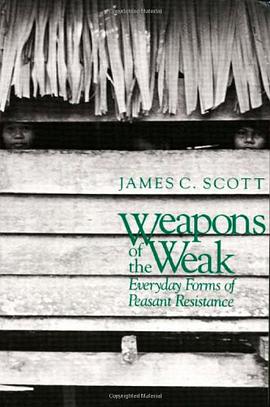
Weapons of the Weak 豆瓣
作者: James C. Scott 出版社: Yale University Press 1987 - 9
Weapons of the Weak is an ethnography by James C. Scott that studies the effects of the Green Revolution in rural Malaysia. One of the main objectives of the study is to make an argument that the Marxian and Gramscian ideas of false consciousness and hegemony are incorrect. He develops this conclusion throughout the book, through the different scenarios and characters that come up during his time of fieldwork in the village. This publication, based on 2 years of fieldwork (1978-1980), focuses on the local class relations in a small rice farming community of 70 households in the main paddy-growing area of Kedah in Malaysia. Introduction of the Green Revolution in 1976 eliminated 2/3 of the wage-earning opportunities for smallholders and landless laborers. The main ensuing class struggle is analyzed being the ideological struggle in the village and the practice of resistance itself consisting of: foot-dragging, dissimulation, desertion, false compliance, pilfering, feigned ignorance and sabotage acts. Rich and poor are engaged in an unremitting if silent struggle to define changes in land tenure, mechanization and employment to advance their own interests, and to use values that they share to control the distribution of status, land, work and grain.
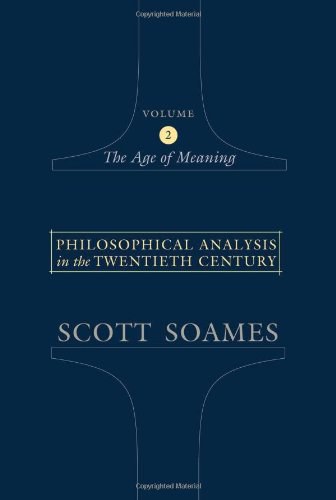
Philosophical Analysis In The Twentieth Century 豆瓣
作者: Scott Soames 出版社: Princeton University Press 2005 - 1
This is a major, wide-ranging history of analytic philosophy since 1900, told by one of the tradition's leading contemporary figures. The first volume takes the story from 1900 to mid-century. The second brings the history up to date.
As Scott Soames tells it, the story of analytic philosophy is one of great but uneven progress, with leading thinkers making important advances toward solving the tradition's core problems. Though no broad philosophical position ever achieved lasting dominance, Soames argues that two methodological developments have, over time, remade the philosophical landscape. These are (1) analytic philosophers' hard-won success in understanding, and distinguishing the notions of logical truth, a priori truth, and necessary truth, and (2) gradual acceptance of the idea that philosophical speculation must be grounded in sound prephilosophical thought. Though Soames views this history in a positive light, he also illustrates the difficulties, false starts, and disappointments endured along the way. As he engages with the work of his predecessors and contemporaries--from Bertrand Russell and Ludwig Wittgenstein to Donald Davidson and Saul Kripke--he seeks to highlight their accomplishments while also pinpointing their shortcomings, especially where their perspectives were limited by an incomplete grasp of matters that have now become clear.
Soames himself has been at the center of some of the tradition's most important debates, and throughout writes with exceptional ease about its often complex ideas. His gift for clear exposition makes the history as accessible to advanced undergraduates as it will be important to scholars. Despite its centrality to philosophy in the English-speaking world, the analytic tradition in philosophy has had very few synthetic histories. This will be the benchmark against which all future accounts will be measured.
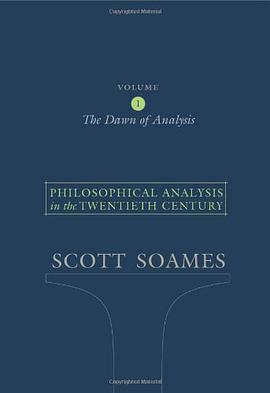
Philosophical Analysis in the Twentieth Century, Volume 1 豆瓣
作者: Scott Soames 出版社: Princeton University Press 2005 - 1
This is a major, wide-ranging history of analytic philosophy since 1900, told by one of the tradition's leading contemporary figures. The first volume takes the story from 1900 to mid-century. The second brings the history up to date.
As Scott Soames tells it, the story of analytic philosophy is one of great but uneven progress, with leading thinkers making important advances toward solving the tradition's core problems. Though no broad philosophical position ever achieved lasting dominance, Soames argues that two methodological developments have, over time, remade the philosophical landscape. These are (1) analytic philosophers' hard-won success in understanding, and distinguishing the notions of logical truth, a priori truth, and necessary truth, and (2) gradual acceptance of the idea that philosophical speculation must be grounded in sound prephilosophical thought. Though Soames views this history in a positive light, he also illustrates the difficulties, false starts, and disappointments endured along the way. As he engages with the work of his predecessors and contemporaries--from Bertrand Russell and Ludwig Wittgenstein to Donald Davidson and Saul Kripke--he seeks to highlight their accomplishments while also pinpointing their shortcomings, especially where their perspectives were limited by an incomplete grasp of matters that have now become clear.
Soames himself has been at the center of some of the tradition's most important debates, and throughout writes with exceptional ease about its often complex ideas. His gift for clear exposition makes the history as accessible to advanced undergraduates as it will be important to scholars. Despite its centrality to philosophy in the English-speaking world, the analytic tradition in philosophy has had very few synthetic histories. This will be the benchmark against which all future accounts will be measured.