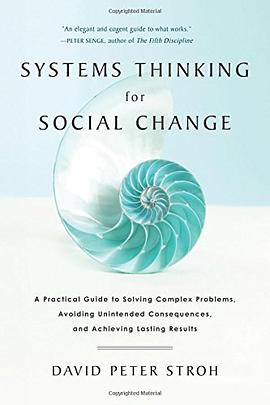
Donors, leaders of nonprofits, and public policy makers usually have the best of intentions to serve society and improve social conditions. But often their solutions fall far short of what they want to accomplish and what is truly needed. Moreover, the answers they propose and fund often produce the opposite of what they want over time. We end up with temporary shelters that increase homelessness, drug busts that increase drug-related crime, or food aid that increases starvation.
How do these unintended consequences come about and how can we avoid them? By applying conventional thinking to complex social problems, we often perpetuate the very problems we try so hard to solve, but it is possible to think differently, and get different results.
Systems Thinking for Social Change enables readers to contribute more effectively to society by helping them understand what systems thinking is and why it is so important in their work. It also gives concrete guidance on how to incorporate systems thinking in problem solving, decision making, and strategic planning without becoming a technical expert.
Systems thinking leader David Stroh walks readers through techniques he has used to help people improve their efforts to end homelessness, improve public health, strengthen education, design a system for early childhood development, protect child welfare, develop rural economies, facilitate the reentry of formerly incarcerated people into society, resolve identity-based conflicts, and more.
The result is a highly readable, effective guide to understanding systems and using that knowledge to get the results you want.
Review
“I don't know of another book in this field that presents the ideas of systems thinking in such a clear and practical way, with so many real-world examples."--Janice Molloy, managing editor, Reflections: The SoL NorthAmerica Journal on Knowledge, Learning, and Change
Publishers Weekly-
"This dense volume will be of genuine use to many in the nonprofit world ... Stroh has a valuable insight to impart: Becoming a more effective systems thinker is not just an analytical task 'but also an emotional, physical, and ultimately spiritual one.' For those dedicated enough to stay with Stroh's message, this book will be a useful beginning.”
“Stroh has offered an important gem in his new book, Systems Thinking for Social Change. Both illuminating and immediately useful, the book shares the key dynamics and success factors gleaned from his long career of working with organizations struggling with society’s most persistent issues. A must read for anyone whose aim is to make a difference on the ground.”--Kristina Wile, co-president, Leverage Networks, and managing partner, Systems Thinking Collaborative
“If there is only one book you read on systems thinking, it should be Systems Thinking for Social Change. If you’re new to systems thinking, I consider this a must read. If you’ve been involved in systems thinking for some time and want a renewed and extended perspective, I highly recommend it. Stroh’s new work covers all the relevant areas appropriate for a solid introduction to systems thinking, though it doesn’t stop there. It makes a serious contribution by detailing a number of real-world situations that have been investigated and improved using the approach presented in the book. And it does very well something that I’ve not seen done before: it not only shows how to map the current system, but also shows how to then create a revised map of how the system is intended to work in the future. This approach ends up identifying where measurements should be made on an ongoing basis to ascertain whether the system is undergoing the intended transformation.”--Gene Bellinger, director, Systems Thinking World, Inc.
“The philanthropic sector has shifted from a ‘charity’ mindset to a focus on changing systems to create sustainable change. Systems Thinking for Social Change offers practical tools for those serious about improving communities and organizations. It doesn’t minimize the complexity, but rather empowers social-change agents with tools to understand the complexity and identify the leverage points.”--Teresa Behrens, director, Institute for Foundation and Donor Learning
“Over fifteen years ago, David Stroh was instrumental in introducing systems thinking to the peace-building field, using tools that have proven to be powerful for improving the effectiveness of our work. This book is a valuable resource for our field ― a must read for all practitioners who have been seeking practical and easy-to-understand guidance on using systems thinking for conflict analysis and strategic planning for better impacts.”--Diana Chigas, professor of practice, Fletcher School of Law and Diplomacy at Tufts University, and co-director of collaborative learning, CDA Collaborative Learning Projects
“This is a must read for public leaders and citizens who are interested in the learning disciplines required for a sustainable, proactive approach to preserving our shared resources.”--Georgianna Bishop, president, The Public Sector Consortium
“For those who have worked for many years in the social-service sector, and who have grown cynical or disillusioned as to whether it is even possible to effect major social change, David Peter Stroh’s book, Systems Thinking for Social Change, is a must read―a clear, thoughtful, and practical guide for those desiring to create lasting social change. But reader beware! Systems thinking is more than a new way of thinking. As Stroh puts it, it is a new way of being. It requires the ability to look at things in a new way, to interact with others differently, to have a clear vision of where you want to go, a willingness to see things the way they are and, finally, the courage to take responsibility for why the system as is isn’t working. If you want to help create long-lasting, effective social change, if you want to say ‘we’re doing it―we’re actually making progress,’ then read this book.”--Anne Miskey, executive director, Funders Together to End Homelessness
“David Stroh, in his invaluable new book, shows that good intentions are not enough for those who aspire to make lasting progress on fundamental social issues―and also how the language and tools of systems theory can provide a deeper understanding of the root causes and help identify the leverage points for productive and sustainable change.”--Russell Eisenstat, executive director, Center for Higher Ambition Leadership
“Societal problems are a swirl of causes, effects, interactions, and contributing relationships. Yet, too often, simplistic answers are applied by the well-intended that only touch on one strand of what is (in reality) a complex and interconnected web. Stroh’s work provides an actionable guide on how to model these relationships―and more importantly how to have a meaningful and lasting impact on them.”--Jason E. Glass, superintendent and chief learner, Eagle County Schools