Amazon.com
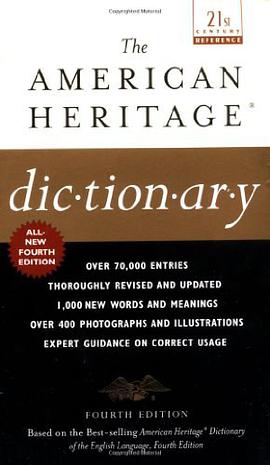
The latest edition of the American Heritage Dictionary is out, and that's hot news--not just for the resolute followers of lexicographical minutiae, but for the general reading and writing public as well. Why? Because the American Heritage is a long-standing favorite family dictionary (never underestimate the value of pictures) and one of the prime dictionary references for magazines, newspapers, and dot.com content providers. For scads of writers and editors across the U.S., it sets the standard on matters of style and lexicographical authority.
So this new edition is exciting and noteworthy, but how good is it? In its favor, the fourth edition is as current a dictionary as you can get. It's six years fresher than the 1994 version, with 10,000 words and definitions you won't find in the still venerable but now slightly dated third edition. For example, unlike its predecessor (and also unlike the 1996 Oxford Encyclopedic English Dictionary), this fourth edition covers dot-com, e-commerce, and soccer mom, Ebonics, Viagra, and a surf definition for cruising television channels and the Internet.
Its panel of special consultants includes authorities on anthropology, architecture, cinema, and law, plus military science, music, religion, and sports, and that is reflected in an impressively comprehensive coverage of the arts, culture, and technology. Sadly, however, there are no medical consultants on the panel, and that loss is felt in some substandard medical definitions. Other flaws: there's a greater than usual tendency to define a word with a form of the same word--for example, fuzzy, whose first two definitions are "1. covered with fuzz." and "2. of or resembling fuzz." And some definitions seem needlessly wordy, such as the entry for furious, which is "full of or characterized by extreme anger; raging." Compare that with the more succinct Oxford Encyclopedic entry: "1. extremely angry. 2. full of fury."
On the other hand, there are valuable entries throughout the dictionary supplying additional information on synonyms, usage, or word history, and these extras, such as the history of diatribe and the usage notes on discomfit, are interesting. The layout is easy on the eyes, with dark blue/green bold type setting the words apart from their definitions, and 4,000 color photographs, maps, and illustrations that are both useful and delightful. On one page, the margin provides color depictions of Francis Bacon, bacterium, and a Bactrian camel. Theodore Roosevelt and a rooster share another margin, while a third page offers Isak Dinesen, a dingo, and dinoflagellate. It is a fascinating book to peruse, and a compellingly scholarly addition to the American Heritage Dictionary line. --Stephanie Gold --This text refers to an out of print or unavailable edition of this title.
From Booklist
Ever since the furor in the U.S. that greeted Webster's Third New International Dictionary (1961) faded, it has become a given that dictionaries should be descriptive rather than prescriptive, a principle sanctified in Britain in the 1850s in Herbert Coleridge's original plan for the monumental project that eventually produced the Oxford English Dictionary. That dictionaries grow by gradual accretion of new words and new senses characterizes the latest edition of the American Heritage Dictionary (AHD), even if it, more than any other contemporary English-language dictionary, flirts with prescriptiveness in some of its usage notes.Reflecting trends in society since publication of the third edition (1992), the most visible additions to the lexicon come from technology. Hence AHD now includes the sense of dot as a synonym for period in computer jargon; a new techie sense for geek; and new entries for dot-com, e-commerce, HTML, HTTP, and URL. These are but a few of the 10,000 new senses or terms incorporated into this edition. Others (e.g., goth, personal watercraft, transgendered) come from the fields of pop culture, entertainment, sports, and business, to name a few.AHD shows two other, much more visible signs of its times. First, the thumbnail marginal illustrations have been transformed from black-and-white to color. This increases their clarity, their utility, and the value they add to definitions. Second, it comes in both print and CD-ROM formats.The CD-ROM (for Windows 95 through 2000 and NT and available for $24.95 if purchased alone) offers content almost identical to that of the print volume and many added features. Some of the illustrations in the print edition are absent from the CD (e.g., mackinaw). This is a small sacrifice for the far greater gains, one of which relates to illustrations. A search feature allows users to display only those terms that contain illustrations, and when any of these is displayed, its thumbnail illustration can be enlarged, offering even greater clarity than the color thumbnails on paper.Other features of the CD-ROM make it an attractive alternative to print, especially for personal use in situations in which it can reside more or less permanently on a PC's CD-ROM drive. A running list of entries in a frame to the left of the display window provides, with much greater precision than the printed dictionary's thumb indexing, quick access to a letter's section. In addition to the word search and A-Z scrolling display of all entries in that left-side window, the window's contents can be limited to display usage notes (usage, synonym, word histories, regional notes), Indo-European roots, Semitic roots, or (as noted) entries containing images. Most entries on the CD-ROM also include an audio icon that, when clicked, plays the word's pronunciation in an audible voice (for some words that of a male, for others that of a female). Just as the Webster's Tenth Collegiate Dictionary allows a toolbar link from Microsoft Word to the dictionary's contents, AHD provides this linkage through a right-mouse click.One other feature demonstrates the dictionary's sense of its times in the age of Internet filters and Dr. Laura controversies: when loading the CD-ROM, the user is asked whether to load the dictionary to include or exclude access to "vulgar" words. This is a latter-day sign of AHD's long willingness to apply usage labels more freely than most of its competitors. Taken by themselves, its usage labels (e.g., "slang," "vulgar") unquestionably appear to be prescriptive. However, when viewed in the context of the dictionary's usage notes, they soften and take on nuance. The usage notes depend heavily upon a large panel of writers and commentators representing diverse views. (What other group can claim both Harold Bloom and Roy Blount Jr and both Antonin Scalia and David Sedaris as members?) The notes convey the panel's uncertainties, disagreements, and qualifiers about how the words are and ought to be used. On the whole, AHD takes an old, inherently prescriptive dictionary device and uses it to describe the majority and minority opinions of a group of facile users of the language. A new category of notes, "Our Living Language," explains how language changes, for example, the reasons why the Ocracoke Island brogue is fading and the attempts to come up with euphemisms for the euphemism downsize. Approximately 1,800 notes of various sorts provide more context and more description than mere labels.When it comes to the things that users turn to a dictionary for most often--definitions, confirmation of spelling, pronunciation--AHD delivers as well as any other respected, respectable desk dictionary. Its definitions are clear and succinct, and they differentiate among senses of a word. Illustrations of words in sentences enhance selected definitions. A pronunciation key on every two-page spread of the print version is the next best thing to the audio on the CD-ROM.AHD long ago established itself as one of the standard American English dictionaries. Its improvements through expansion, refinement, and extension to the CD-ROM medium ensure its vitality and its value to a broad audience, from junior high on. RBB
Copyright © American Library Association. All rights reserved --This text refers to an out of print or unavailable edition of this title.