learning
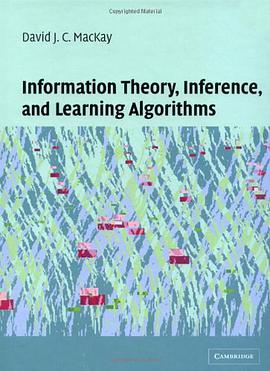
Information Theory, Inference and Learning Algorithms 豆瓣 Goodreads
Information Theory, Inference & Learning Algorithms
10.0 (5 个评分) 作者: David J. C. MacKay 出版社: Cambridge University Press 2003 - 10
Information theory and inference, taught together in this exciting textbook, lie at the heart of many important areas of modern technology - communication, signal processing, data mining, machine learning, pattern recognition, computational neuroscience, bioinformatics and cryptography. The book introduces theory in tandem with applications. Information theory is taught alongside practical communication systems such as arithmetic coding for data compression and sparse-graph codes for error-correction. Inference techniques, including message-passing algorithms, Monte Carlo methods and variational approximations, are developed alongside applications to clustering, convolutional codes, independent component analysis, and neural networks. Uniquely, the book covers state-of-the-art error-correcting codes, including low-density-parity-check codes, turbo codes, and digital fountain codes - the twenty-first-century standards for satellite communications, disk drives, and data broadcast. Richly illustrated, filled with worked examples and over 400 exercises, some with detailed solutions, the book is ideal for self-learning, and for undergraduate or graduate courses. It also provides an unparalleled entry point for professionals in areas as diverse as computational biology, financial engineering and machine learning.
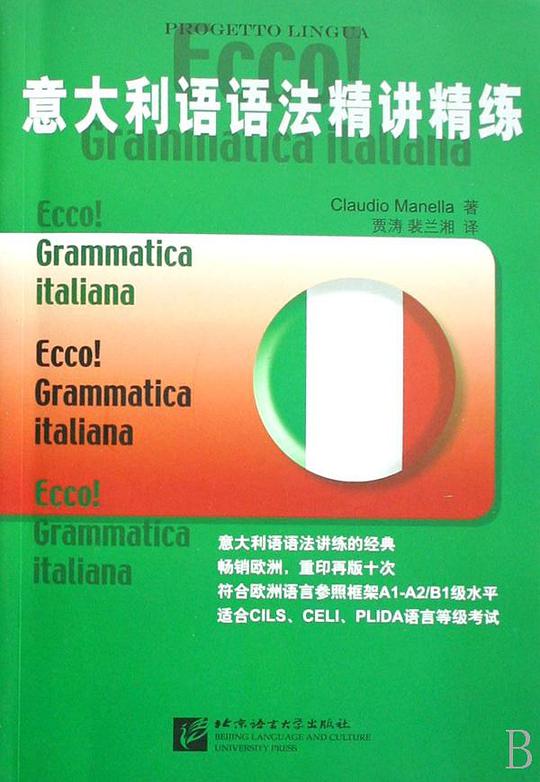
意大利语语法精讲精练 豆瓣
作者: (意)马内拉 译者: 贾涛 / 裴兰湘 出版社: 北京语言文化大学出版社 2008
意大利语语法讲练的经典
畅销欧洲,重印再版十次
符合欧洲语言参照框架A1~A2/B2级水平
适合CILS,CELI,PLIDA语言等级考试
Unita 1 第一单元 Gli articoli,i nomi e gli aggettivi冠词、名词和形容词
Unita 2 第二单元 I verbi动词 Modo Indicativo直陈式 Presente现在时 Passato prossimo近过去时 Passato remoto远过去时 Imperfetto未完成过去时 Futuro semplice简单将来时 Futuro composto先将来时 Trapassato prossimo近愈过去时 La Concordanza dei Tempi del Modo Indicativo直陈式的时态配合 Modo Congiuntivo虚拟式 Congiuntivo Presente虚拟式现在时 Congiuntivo Passato虚拟式现在完成时 Congiuntivo Imperfetto虚拟式未完成过去时 Congiuntivo Trapassato虚拟式愈过去时 La Coneordanza dei Tempi del Modo Congiuntivo虚拟式的时态配合 Modo Condizionale条件式 Condizionale Semplice条件式简单式 Condizionale Composto条件式复合式 Modo Imperativo命令式 Modo Gerundio副动词 Modi lnfinito e Participio不定式和分词式
Unita 3 第三单元 La forma riflessiva自反形式
Unita 4 第四单元 Le preposizioni前置词
Unita 5 第五单元 I pronomi代词
Unita 6 第六单元 Gli aggettivi possessivi e dimostrativi物主形容词和指示形容词 Possessivi物主词(形容词)
Unita 7 第七单元 I relativi e g Ji interrogativi关系词和疑问词 I relativi关系词(che),(cui),(quale)
Unita 8 第八单元 La forma passiva被动式
Unita 9 第九单元 La forma impersonale不定人称式
Unita 10 第十单元 II periodo ipotetico假设句
Chiavi答案 degli esercizi e dei test练习与测试 Dizionario词汇表 Italiano-Cinese意汉对照
每个单元后面都有练习题,书后面都有对照的答案.
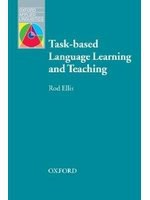
Task-based Language Learning and Teaching (Oxford Applied Linguistics) 豆瓣
作者: Rod Ellis 出版社: Oxford University Press, USA 2003 - 4
This book explores the relationship between research, teaching, and tasks, and seeks to clarify the issues raised by recent work in this field. The book shows how research and task-based teaching can mutually inform each other and illuminate the areas of task-based course design, methodology, and assessment. The author brings an accessible style and broad scope to an area of contemporary importance to both SLA and language pedagogy.
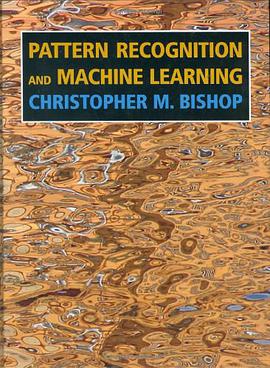
Pattern Recognition and Machine Learning 豆瓣 Goodreads
Pattern Recognition and Machine Learning (Information Science and Statistics)
9.8 (19 个评分) 作者: Christopher Bishop 出版社: Springer 2007 - 10
The dramatic growth in practical applications for machine learning over the last ten years has been accompanied by many important developments in the underlying algorithms and techniques. For example, Bayesian methods have grown from a specialist niche to become mainstream, while graphical models have emerged as a general framework for describing and applying probabilistic techniques. The practical applicability of Bayesian methods has been greatly enhanced by the development of a range of approximate inference algorithms such as variational Bayes and expectation propagation, while new models based on kernels have had a significant impact on both algorithms and applications.
This completely new textbook reflects these recent developments while providing a comprehensive introduction to the fields of pattern recognition and machine learning. It is aimed at advanced undergraduates or first-year PhD students, as well as researchers and practitioners. No previous knowledge of pattern recognition or machine learning concepts is assumed. Familiarity with multivariate calculus and basic linear algebra is required, and some experience in the use of probabilities would be helpful though not essential as the book includes a self-contained introduction to basic probability theory.
The book is suitable for courses on machine learning, statistics, computer science, signal processing, computer vision, data mining, and bioinformatics. Extensive support is provided for course instructors, including more than 400 exercises, graded according to difficulty. Example solutions for a subset of the exercises are available from the book web site, while solutions for the remainder can be obtained by instructors from the publisher. The book is supported by a great deal of additional material, and the reader is encouraged to visit the book web site for the latest information.