The Quotable Mises 豆瓣
作者:
Mark Thornton
出版社:
Ludwig von Mises Institute
2005
- 9
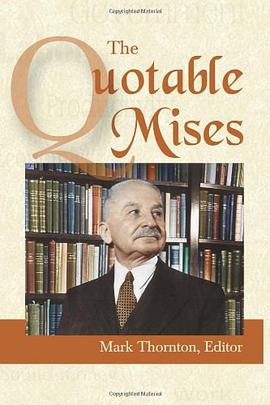
The Quotable Mises, edited by Mark Thornton and published by the Mises Institute, is 300-plus pages of some of the most thrilling words on politics and economics ever written.
In some ways, it is the perfect introduction to Mises's thought, something that immediately grabs one's attention and gives a fast and accessible presentation of the range of his ideas.
The content is Mises in a brand-new way, in a way that you have never encountered him before. Each page exudes energy and wisdom. After we sent it to Bettina-Bien Greaves, she wrote us to say: "A thrilling project, a thorough job, and a marvelous result. The Quotable Mises performs a great service."
Just consider these quotations from Mises that are included:
The issue is always the same: the government or the market. There is no third solution.
If history could teach us anything, it would be that private property is inextricably linked with civilization.
What distinguishes civilized man from a barbarian must be acquired by every individual anew.
Go into the home of the average American family and you will see for whom the wheels of the machines are turning.
Those who are asking for more government interference are asking ultimately for more compulsion and less freedom.
Governments become liberal only when forced to by the citizens.
Both force and money are impotent against ideas.
The comparatively greater prosperity of the United States is an outcome of the fact that the New Deal did not come in 1900 or 1910, but only in 1933.
The worst and most dangerous form of absolutist rule is that of an intolerant majority.
War prosperity is like the prosperity that an earthquake or a plague brings. The earthquake means good business for construction workers, and cholera improves the business of physicians, pharmacists, and undertakers; but no one has for that reason yet sought to celebrate earthquakes and cholera as stimulators of the productive forces in the general interest.
Economics deals with real man, weak and subject to error as he is, not with ideal beings omniscient and perfect as only gods could be.
The biggest struggle in putting the book together was not in finding enough quotes but in limiting the number. The editor tried to provide a representative list of topics and subjects that Mises is most famous for such as socialism, bureaucracy, interventionism, money, government, and war. But he also included many subject areas for which Mises is not often quoted, including arts, fate, health, instinct, martyrdom, religion, and youth.
Most economists don't write enough memorable material in an entire lifetime to fill 20 pages. But Mises was different. He was brilliant, brave, and tenacious. He could also write. He wanted to reach all people, not just specialists.
This serves as an introduction and guide to his thought, or even a kind of concordance, all in his own words. Mostly it is a means for putting Mises's ideas in even greater circulation.
After all it was Mises who said:
"In the long run even the most despotic governments with all their brutality and cruelty are no match for ideas. Eventually the ideology that has won the support of the majority will prevail and cut the ground from under the tyrant's feet. Then the oppressed many will rise in rebellion and overthrow their masters."
This is the Mises book for Everyman, for yourself and every thoughtful man and woman you know.
In some ways, it is the perfect introduction to Mises's thought, something that immediately grabs one's attention and gives a fast and accessible presentation of the range of his ideas.
The content is Mises in a brand-new way, in a way that you have never encountered him before. Each page exudes energy and wisdom. After we sent it to Bettina-Bien Greaves, she wrote us to say: "A thrilling project, a thorough job, and a marvelous result. The Quotable Mises performs a great service."
Just consider these quotations from Mises that are included:
The issue is always the same: the government or the market. There is no third solution.
If history could teach us anything, it would be that private property is inextricably linked with civilization.
What distinguishes civilized man from a barbarian must be acquired by every individual anew.
Go into the home of the average American family and you will see for whom the wheels of the machines are turning.
Those who are asking for more government interference are asking ultimately for more compulsion and less freedom.
Governments become liberal only when forced to by the citizens.
Both force and money are impotent against ideas.
The comparatively greater prosperity of the United States is an outcome of the fact that the New Deal did not come in 1900 or 1910, but only in 1933.
The worst and most dangerous form of absolutist rule is that of an intolerant majority.
War prosperity is like the prosperity that an earthquake or a plague brings. The earthquake means good business for construction workers, and cholera improves the business of physicians, pharmacists, and undertakers; but no one has for that reason yet sought to celebrate earthquakes and cholera as stimulators of the productive forces in the general interest.
Economics deals with real man, weak and subject to error as he is, not with ideal beings omniscient and perfect as only gods could be.
The biggest struggle in putting the book together was not in finding enough quotes but in limiting the number. The editor tried to provide a representative list of topics and subjects that Mises is most famous for such as socialism, bureaucracy, interventionism, money, government, and war. But he also included many subject areas for which Mises is not often quoted, including arts, fate, health, instinct, martyrdom, religion, and youth.
Most economists don't write enough memorable material in an entire lifetime to fill 20 pages. But Mises was different. He was brilliant, brave, and tenacious. He could also write. He wanted to reach all people, not just specialists.
This serves as an introduction and guide to his thought, or even a kind of concordance, all in his own words. Mostly it is a means for putting Mises's ideas in even greater circulation.
After all it was Mises who said:
"In the long run even the most despotic governments with all their brutality and cruelty are no match for ideas. Eventually the ideology that has won the support of the majority will prevail and cut the ground from under the tyrant's feet. Then the oppressed many will rise in rebellion and overthrow their masters."
This is the Mises book for Everyman, for yourself and every thoughtful man and woman you know.