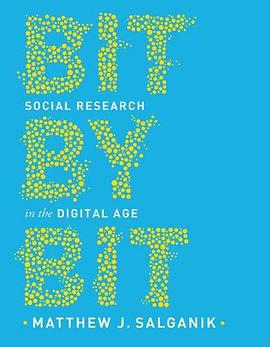
An innovative and accessible guide to doing social research in the digital age
In just the past several years, we have witnessed the birth and rapid spread of social media, mobile phones, and numerous other digital marvels. In addition to changing how we live, these tools enable us to collect and process data about human behavior on a scale never before imaginable, offering entirely new approaches to core questions about social behavior. Bit by Bit is the key to unlocking these powerful methods―a landmark book that will fundamentally change how the next generation of social scientists and data scientists explores the world around us.
Bit by Bit is the essential guide to mastering the key principles of doing social research in this fast-evolving digital age. In this comprehensive yet accessible book, Matthew Salganik explains how the digital revolution is transforming how social scientists observe behavior, ask questions, run experiments, and engage in mass collaborations. He provides a wealth of real-world examples throughout, and also lays out a principles-based approach to handling ethical challenges in the era of social media.
Bit by Bit is an invaluable resource for social scientists who want to harness the research potential of big data and a must-read for data scientists interested in applying the lessons of social science to tomorrow’s technologies.
Illustrates important ideas with examples of outstanding research
Combines ideas from social science and data science in an accessible style and without jargon
Goes beyond the analysis of “found” data to discuss the collection of “designed” data such as surveys, experiments, and mass collaboration
Features an entire chapter on ethics
Includes extensive suggestions for further reading and activities for the classroom or self-study