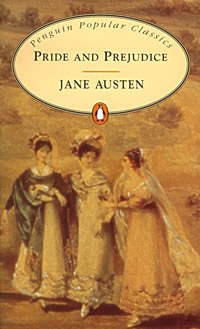
Pride and Prejudice Douban
author:
[英国] 简·奥斯汀
publishing house:
Penguin Classics
1994
- 2
"It is a truth universally acknowledged, that a single man in possession of a good fortune, must be in want of a wife."
Next to the exhortation at the beginning of Moby-Dick, "Call me Ishmael," the first sentence of Jane Austen's Pride and Prejudice must be among the most quoted in literature. And certainly what Melville did for whaling Austen does for marriage--tracing the intricacies (not to mention the economics) of 19th-century British mating rituals with a sure hand and an unblinking eye. As usual, Austen trains her sights on a country village and a few families--in this case, the Bennets, the Philips, and the Lucases. Into their midst comes Mr. Bingley, a single man of good fortune, and his friend, Mr. Darcy, who is even richer. Mrs. Bennet, who married above her station, sees their arrival as an opportunity to marry off at least one of her five daughters. Bingley is complaisant and easily charmed by the eldest Bennet girl, Jane; Darcy, however, is harder to please. Put off by Mrs. Bennet's vulgarity and the untoward behavior of the three younger daughters, he is unable to see the true worth of the older girls, Jane and Elizabeth. His excessive pride offends Lizzy, who is more than willing to believe the worst that other people have to say of him; when George Wickham, a soldier stationed in the village, does indeed have a discreditable tale to tell, his words fall on fertile ground.
Having set up the central misunderstanding of the novel, Austen then brings in her cast of fascinating secondary characters: Mr. Collins, the sycophantic clergyman who aspires to Lizzy's hand but settles for her best friend, Charlotte, instead; Lady Catherine de Bourgh, Mr. Darcy's insufferably snobbish aunt; and the Gardiners, Jane and Elizabeth's low-born but noble-hearted aunt and uncle. Some of Austen's best comedy comes from mixing and matching these representatives of different classes and economic strata, demonstrating the hypocrisy at the heart of so many social interactions. And though the novel is rife with romantic misunderstandings, rejected proposals, disastrous elopements, and a requisite happy ending for those who deserve one, Austen never gets so carried away with the romance that she loses sight of the hard economic realities of 19th-century matrimonial maneuvering. Good marriages for penniless girls such as the Bennets are hard to come by, and even Lizzy, who comes to sincerely value Mr. Darcy, remarks when asked when she first began to love him: "It has been coming on so gradually, that I hardly know when it began. But I believe I must date it from my first seeing his beautiful grounds at Pemberley." She may be joking, but there's more than a little truth to her sentiment, as well. Jane Austen considered Elizabeth Bennet "as delightful a creature as ever appeared in print". Readers of Pride and Prejudice would be hard-pressed to disagree. --Alix Wilber --This text refers to an out of print or unavailable edition of this title.
Austen is the hot property of the entertainment world with new feature film versions of Persuasion and Sense and Sensibility on the silver screen and Pride and Prejudice hitting the TV airwaves on PBS. Such high visibility will inevitably draw renewed interest in the original source materials. These new Modern Library editions offer quality hardcovers at affordable prices.
Copyright 1996 Reed Business Information, Inc. --This text refers to the Hardcover edition.
Jane Lapotaire, known to American audiences from her many PBS appearances, is a perfect choice to read Jane Austen's comedy of manners. Her rich and varied intonations capture just the right blend of artifice and empathy to recreate not only the lively and playfully witty Elizabeth Bennett and the handsome, albeit conceited, Mr. Darcy, but also the entire gamut of Bennett family members, friends and foes. Amazingly, Lapotaire even manages to conjure memories of the screen's Mr. D', Lawrence Olivier. This is an exquisite audio abridgment of the classic English satire. L.(H.)B. (c)AudioFile, Portland, Maine --This text refers to an out of print or unavailable edition of this title.
We recently purchased three of your classics series hardcovers for our 15 year old daughter's birthday, and she was estatic. The books are beautifully done, and it was nice to see that they used the original versions' formatting. We anxiously look forward to any new volumes you may add. If we might make a suggestion for a future addition to this series, please consider Treasure Island, as this would be a most welcome addition to her new collection. Thanks for producing a wonderful product. --This text refers to an out of print or unavailable edition of this title.
"It is a truth universally acknowledged that a single man in possession of a good fortune must be in want of a wife." --This text refers to an out of print or unavailable edition of this title.
"Cover to Cover's unabridged readings of classic novels are in a class of their own." --This text refers to the Audio Cassette edition.
"These Cover to Cover tapes offer up a delectable feast for fans of the spoken word. We're talking class act here-from the elegant covers to the accomplished readers." --This text refers to the Audio Cassette edition.
"Irene Sutcliffe provides the passionate and strong reading of Austen's classic story." --This text refers to the Audio Cassette edition.
"Jane Austen's Pride and Prejudice is read here by Irene Sutcliffe and is a delight from beginning to end." --This text refers to the Audio Cassette edition.
"The wit of Jane Austen has for partner the perfection of her taste."
--Virginia Woolf --This text refers to the Paperback edition.
Next to the exhortation at the beginning of Moby-Dick, "Call me Ishmael," the first sentence of Jane Austen's Pride and Prejudice must be among the most quoted in literature. And certainly what Melville did for whaling Austen does for marriage--tracing the intricacies (not to mention the economics) of 19th-century British mating rituals with a sure hand and an unblinking eye. As usual, Austen trains her sights on a country village and a few families--in this case, the Bennets, the Philips, and the Lucases. Into their midst comes Mr. Bingley, a single man of good fortune, and his friend, Mr. Darcy, who is even richer. Mrs. Bennet, who married above her station, sees their arrival as an opportunity to marry off at least one of her five daughters. Bingley is complaisant and easily charmed by the eldest Bennet girl, Jane; Darcy, however, is harder to please. Put off by Mrs. Bennet's vulgarity and the untoward behavior of the three younger daughters, he is unable to see the true worth of the older girls, Jane and Elizabeth. His excessive pride offends Lizzy, who is more than willing to believe the worst that other people have to say of him; when George Wickham, a soldier stationed in the village, does indeed have a discreditable tale to tell, his words fall on fertile ground.
Having set up the central misunderstanding of the novel, Austen then brings in her cast of fascinating secondary characters: Mr. Collins, the sycophantic clergyman who aspires to Lizzy's hand but settles for her best friend, Charlotte, instead; Lady Catherine de Bourgh, Mr. Darcy's insufferably snobbish aunt; and the Gardiners, Jane and Elizabeth's low-born but noble-hearted aunt and uncle. Some of Austen's best comedy comes from mixing and matching these representatives of different classes and economic strata, demonstrating the hypocrisy at the heart of so many social interactions. And though the novel is rife with romantic misunderstandings, rejected proposals, disastrous elopements, and a requisite happy ending for those who deserve one, Austen never gets so carried away with the romance that she loses sight of the hard economic realities of 19th-century matrimonial maneuvering. Good marriages for penniless girls such as the Bennets are hard to come by, and even Lizzy, who comes to sincerely value Mr. Darcy, remarks when asked when she first began to love him: "It has been coming on so gradually, that I hardly know when it began. But I believe I must date it from my first seeing his beautiful grounds at Pemberley." She may be joking, but there's more than a little truth to her sentiment, as well. Jane Austen considered Elizabeth Bennet "as delightful a creature as ever appeared in print". Readers of Pride and Prejudice would be hard-pressed to disagree. --Alix Wilber --This text refers to an out of print or unavailable edition of this title.
Austen is the hot property of the entertainment world with new feature film versions of Persuasion and Sense and Sensibility on the silver screen and Pride and Prejudice hitting the TV airwaves on PBS. Such high visibility will inevitably draw renewed interest in the original source materials. These new Modern Library editions offer quality hardcovers at affordable prices.
Copyright 1996 Reed Business Information, Inc. --This text refers to the Hardcover edition.
Jane Lapotaire, known to American audiences from her many PBS appearances, is a perfect choice to read Jane Austen's comedy of manners. Her rich and varied intonations capture just the right blend of artifice and empathy to recreate not only the lively and playfully witty Elizabeth Bennett and the handsome, albeit conceited, Mr. Darcy, but also the entire gamut of Bennett family members, friends and foes. Amazingly, Lapotaire even manages to conjure memories of the screen's Mr. D', Lawrence Olivier. This is an exquisite audio abridgment of the classic English satire. L.(H.)B. (c)AudioFile, Portland, Maine --This text refers to an out of print or unavailable edition of this title.
We recently purchased three of your classics series hardcovers for our 15 year old daughter's birthday, and she was estatic. The books are beautifully done, and it was nice to see that they used the original versions' formatting. We anxiously look forward to any new volumes you may add. If we might make a suggestion for a future addition to this series, please consider Treasure Island, as this would be a most welcome addition to her new collection. Thanks for producing a wonderful product. --This text refers to an out of print or unavailable edition of this title.
"It is a truth universally acknowledged that a single man in possession of a good fortune must be in want of a wife." --This text refers to an out of print or unavailable edition of this title.
"Cover to Cover's unabridged readings of classic novels are in a class of their own." --This text refers to the Audio Cassette edition.
"These Cover to Cover tapes offer up a delectable feast for fans of the spoken word. We're talking class act here-from the elegant covers to the accomplished readers." --This text refers to the Audio Cassette edition.
"Irene Sutcliffe provides the passionate and strong reading of Austen's classic story." --This text refers to the Audio Cassette edition.
"Jane Austen's Pride and Prejudice is read here by Irene Sutcliffe and is a delight from beginning to end." --This text refers to the Audio Cassette edition.
"The wit of Jane Austen has for partner the perfection of her taste."
--Virginia Woolf --This text refers to the Paperback edition.