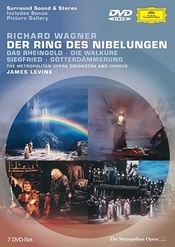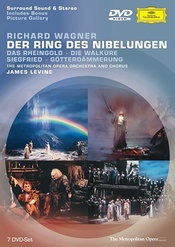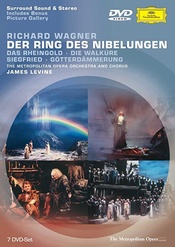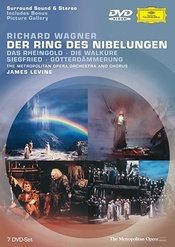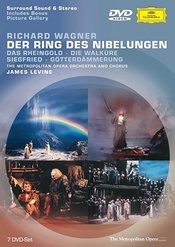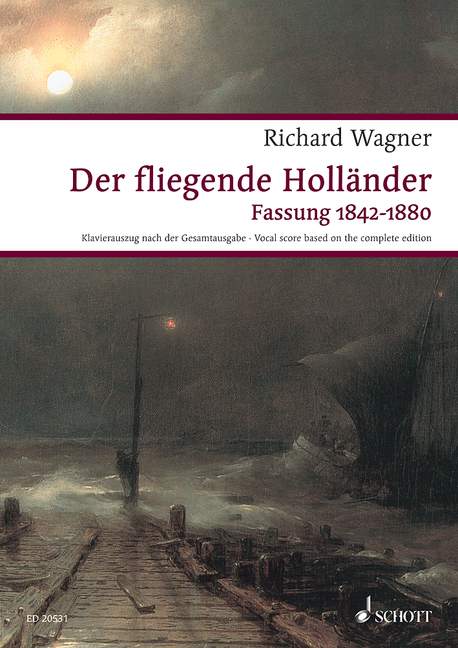
威廉·理查德·瓦格纳 — 作曲 (67)
漂泊的荷兰人 2012年中国国家大剧院版 [演出] 豆瓣
所属 演出: 漂泊的荷兰人
语言: german 德语 剧团: 中国国家大剧院管弦乐团;中国国家大剧院合唱团 剧院: 中国国家大剧院 导演: Giancarlo del Monaco
其它标题: 2012年中国国家大剧院版 编剧: Richard Wagner 作曲: Richard Wagner 演员: Thomas Gazheli / 章亚伦 / Eva Johansson / 孙秀苇
Place: On the coast of Norway
Act 1
On his homeward journey, the sea captain Daland is compelled by stormy weather to seek a port of refuge near Sandwike in southern Norway. He leaves the helmsman on watch and he and the sailors retire. (Song of the helmsman: "Mit Gewitter und Sturm aus fernem Meer" — "With tempest and storm on distant seas.") The helmsman falls asleep. A ghostly vessel appearing astern is dashed against Daland's vessel by the sea and the grappling irons hold the two ships together. Invisible hands furl the sails. A man of pale aspect, dressed in black, his face framed by a thick black beard, steps ashore. He laments his fate. (Aria: "Die Frist ist um, und abermals verstrichen sind sieben Jahr" — "The time has come and seven years have again elapsed") Because he once invoked Satan, the ghost captain is cursed to roam the sea forever without rest. An angel brought to him the terms of his redemption: Every seven years the waves will cast him upon the shore; if he can find a wife who will be true to him he will be released from his curse.
Daland wakes up and meets the stranger. The stranger hears that Daland has an unmarried daughter named Senta, and he asks for her hand in marriage, offering a chest of treasure as a gift. Tempted by gold, Daland agrees to the marriage. The southwind blows and both vessels set sail for Daland's home.
Act 2
A group of local girls are singing and spinning in Daland's house. (Spinning chorus: "Summ und brumm, du gutes Rädchen" — "Whir and whirl, good wheel") Senta, Daland's daughter, dreamily gazes upon a gorgeous picture of the legendary Dutchman that hangs from the wall; she desires to save him. Against the will of her nurse, she sings to her friends the story of the Dutchman (Ballad with the Leitmotiv), how Satan heard him swear and took him at his word. She vows to save him by her fidelity.
The huntsman Erik, Senta's former boyfriend, arrives and hears her; the girls depart, and the huntsman, who loves the maiden, warns her, telling her of his dream, in which Daland returned with a mysterious stranger, who carried her off to sea. She listens with delight, and Erik leaves in despair.
Daland arrives with the stranger; he and Senta stand gazing at each other in silence. Daland is scarcely noticed by his daughter, even when he presents his guest as her betrothed. In the following duet, which closes the act, Senta swears to be true till death.
Act 3
Later in the evening, the local girls bring Daland's men food and drink. They invite the crew of the strange vessel to join in the merry-making, but in vain. The girls retire in wonder; ghostly forms appear at work upon the vessel The Flying Dutchman, and Daland's men retreat in fear.
Senta arrives, followed by Erik, who reproves her for deserting him, as she had formerly loved him and vowed constancy. When the stranger, who has been listening, hears these words, he is overwhelmed with despair, as he thinks he is now forever lost. He summons his men, tells Senta of the curse, and to the consternation of Daland and his crew declares that he is the "Flying Dutchman".
As the Dutchman sets sail, Senta throws herself into the sea, claiming that she will be faithful to him unto death. This is his salvation. The spectral ship disappears, and Senta and the Dutchman are seen ascending to heaven.
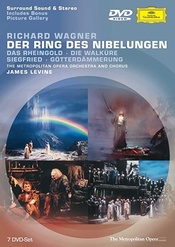
尼伯龙人的指环 2016年维也纳国家歌剧院版 [演出] 豆瓣
所属 演出: 尼伯龙人的指环
语言: 德语 german 剧团: Orchester der Wiener Staatsoper 维也纳国家歌剧院管弦乐团 ; Chor der Wiener Staatsoper 维也纳国家歌剧院合唱团 剧院: Wiener Staatsoper 维也纳国家歌剧院 导演: Sven-Eric Bechtolf
其它标题: 2016年维也纳国家歌剧院版 编剧: Richard Wagner 作曲: Richard Wagner 演员: Linda Watson / Christian Franz
The plot revolves around a magic ring that grants the power to rule the world, forged by the Nibelung dwarf Alberich from gold he stole from the Rhine maidens in the river Rhine. The Ring itself as described by Wagner is a Rune-magic taufr ("tine", or "talisman") intended to rule the feminine multiplicative power by a fearful magical act termed as 'denial of love' ("Liebesverzicht"). With the assistance of the god Loge, Wotan – the chief of the gods – steals the ring from Alberich, but is forced to hand it over to the giants, Fafner and Fasolt in payment for building the home of the gods, Valhalla, or they will take Freia, who provides the gods with the golden apples that keep them young. Wotan's schemes to regain the ring, spanning generations, drive much of the action in the story. His grandson, the mortal Siegfried, wins the ring by slaying Fafner (who slew Fasolt for the ring) – as Wotan intended – but is eventually betrayed and slain as a result of the intrigues of Alberich's son Hagen, who wants the ring for himself. Finally, the Valkyrie Brünnhilde – Siegfried's lover and Wotan's daughter who lost her immortality for defying her father in an attempt to save Siegfried's father Sigmund – returns the ring to the Rhine maidens as she commits suicide on Siegfried's funeral pyre. Hagen is drowned as he attempts to recover the ring. In the process, the gods and Valhalla are destroyed.
Details of the storylines can be found in the articles on each music drama.
Wagner created the story of the Ring by fusing elements from many German and Scandinavian myths and folk tales. The Old Norse Edda supplied much of the material for Das Rheingold, while Die Walküre was largely based on the Völsunga saga. Siegfried contains elements from the Eddur, the Völsunga saga and Thidrekssaga. The final Götterdämmerung, draws from the 12th-century German poem, the Nibelungenlied, which appears to have been the original inspiration for the Ring.
The Ring has been the subject of myriad interpretations. For example, George Bernard Shaw, in The Perfect Wagnerite, argues for a view of The Ring as an essentially socialist critique of industrial society and its abuses. Robert Donington in Wagner's Ring And Its Symbols interprets it in terms of Jungian psychology, as an account of the development of unconscious archetypes in the mind, leading towards individuation.
尼伯龙人的指环 2010-2012年大都会歌剧团版 [演出] 豆瓣
所属 演出: 尼伯龙人的指环
语言: 德语 german 剧团: Metropolitan Opera Orchestra 大都会歌剧团管弦乐团 ; Metropolitan Opera Chorus 大都会歌剧团合唱团 剧院: Metropolitan Opera House 大都会歌剧院 导演: Robert Lepage
其它标题: 2010-2012年大都会歌剧团版 编剧: Richard Wagner 作曲: Richard Wagner 演员: Deborah Voigt / Jay Hunter Morris
The plot revolves around a magic ring that grants the power to rule the world, forged by the Nibelung dwarf Alberich from gold he stole from the Rhine maidens in the river Rhine. The Ring itself as described by Wagner is a Rune-magic taufr ("tine", or "talisman") intended to rule the feminine multiplicative power by a fearful magical act termed as 'denial of love' ("Liebesverzicht"). With the assistance of the god Loge, Wotan – the chief of the gods – steals the ring from Alberich, but is forced to hand it over to the giants, Fafner and Fasolt in payment for building the home of the gods, Valhalla, or they will take Freia, who provides the gods with the golden apples that keep them young. Wotan's schemes to regain the ring, spanning generations, drive much of the action in the story. His grandson, the mortal Siegfried, wins the ring by slaying Fafner (who slew Fasolt for the ring) – as Wotan intended – but is eventually betrayed and slain as a result of the intrigues of Alberich's son Hagen, who wants the ring for himself. Finally, the Valkyrie Brünnhilde – Siegfried's lover and Wotan's daughter who lost her immortality for defying her father in an attempt to save Siegfried's father Sigmund – returns the ring to the Rhine maidens as she commits suicide on Siegfried's funeral pyre. Hagen is drowned as he attempts to recover the ring. In the process, the gods and Valhalla are destroyed.
Details of the storylines can be found in the articles on each music drama.
Wagner created the story of the Ring by fusing elements from many German and Scandinavian myths and folk tales. The Old Norse Edda supplied much of the material for Das Rheingold, while Die Walküre was largely based on the Völsunga saga. Siegfried contains elements from the Eddur, the Völsunga saga and Thidrekssaga. The final Götterdämmerung, draws from the 12th-century German poem, the Nibelungenlied, which appears to have been the original inspiration for the Ring.
The Ring has been the subject of myriad interpretations. For example, George Bernard Shaw, in The Perfect Wagnerite, argues for a view of The Ring as an essentially socialist critique of industrial society and its abuses. Robert Donington in Wagner's Ring And Its Symbols interprets it in terms of Jungian psychology, as an account of the development of unconscious archetypes in the mind, leading towards individuation.
尼伯龙人的指环 1979-1980年拜罗伊特音乐节版 [演出] 豆瓣
所属 演出: 尼伯龙人的指环
语言: german 德语 剧团: Bayreuther Festspielorchester 拜罗伊特音乐节管弦乐团 ; Bayreuther Festspielchor 拜罗伊特音乐节合唱团 剧院: Bayreuther Festspielhaus 拜罗伊特音乐节剧院 导演: Patrice Chéreau
其它标题: 1979-1980年拜罗伊特音乐节版 编剧: Richard Wagner 作曲: Richard Wagner 演员: Gwyneth Jones / Manfred Jung
The plot revolves around a magic ring that grants the power to rule the world, forged by the Nibelung dwarf Alberich from gold he stole from the Rhine maidens in the river Rhine. The Ring itself as described by Wagner is a Rune-magic taufr ("tine", or "talisman") intended to rule the feminine multiplicative power by a fearful magical act termed as 'denial of love' ("Liebesverzicht"). With the assistance of the god Loge, Wotan – the chief of the gods – steals the ring from Alberich, but is forced to hand it over to the giants, Fafner and Fasolt in payment for building the home of the gods, Valhalla, or they will take Freia, who provides the gods with the golden apples that keep them young. Wotan's schemes to regain the ring, spanning generations, drive much of the action in the story. His grandson, the mortal Siegfried, wins the ring by slaying Fafner (who slew Fasolt for the ring) – as Wotan intended – but is eventually betrayed and slain as a result of the intrigues of Alberich's son Hagen, who wants the ring for himself. Finally, the Valkyrie Brünnhilde – Siegfried's lover and Wotan's daughter who lost her immortality for defying her father in an attempt to save Siegfried's father Sigmund – returns the ring to the Rhine maidens as she commits suicide on Siegfried's funeral pyre. Hagen is drowned as he attempts to recover the ring. In the process, the gods and Valhalla are destroyed.
Details of the storylines can be found in the articles on each music drama.
Wagner created the story of the Ring by fusing elements from many German and Scandinavian myths and folk tales. The Old Norse Edda supplied much of the material for Das Rheingold, while Die Walküre was largely based on the Völsunga saga. Siegfried contains elements from the Eddur, the Völsunga saga and Thidrekssaga. The final Götterdämmerung, draws from the 12th-century German poem, the Nibelungenlied, which appears to have been the original inspiration for the Ring.
The Ring has been the subject of myriad interpretations. For example, George Bernard Shaw, in The Perfect Wagnerite, argues for a view of The Ring as an essentially socialist critique of industrial society and its abuses. Robert Donington in Wagner's Ring And Its Symbols interprets it in terms of Jungian psychology, as an account of the development of unconscious archetypes in the mind, leading towards individuation.
尼伯龙人的指环 1989-1990年大都会歌剧团版 [演出] 豆瓣
所属 演出: 尼伯龙人的指环
语言: german 德语 剧团: Metropolitan Opera Orchestra 大都会歌剧团管弦乐团 ; Metropolitan Opera Chorus 大都会歌剧团合唱团 剧院: Metropolitan Opera House 大都会歌剧院 导演: Otto Schenk / Phebe Berkowitz
其它标题: 1989-1990年大都会歌剧团版 编剧: Richard Wagner 作曲: Richard Wagner 演员: Hildegard Behrens / Siegfried Jerusalem
The plot revolves around a magic ring that grants the power to rule the world, forged by the Nibelung dwarf Alberich from gold he stole from the Rhine maidens in the river Rhine. The Ring itself as described by Wagner is a Rune-magic taufr ("tine", or "talisman") intended to rule the feminine multiplicative power by a fearful magical act termed as 'denial of love' ("Liebesverzicht"). With the assistance of the god Loge, Wotan – the chief of the gods – steals the ring from Alberich, but is forced to hand it over to the giants, Fafner and Fasolt in payment for building the home of the gods, Valhalla, or they will take Freia, who provides the gods with the golden apples that keep them young. Wotan's schemes to regain the ring, spanning generations, drive much of the action in the story. His grandson, the mortal Siegfried, wins the ring by slaying Fafner (who slew Fasolt for the ring) – as Wotan intended – but is eventually betrayed and slain as a result of the intrigues of Alberich's son Hagen, who wants the ring for himself. Finally, the Valkyrie Brünnhilde – Siegfried's lover and Wotan's daughter who lost her immortality for defying her father in an attempt to save Siegfried's father Sigmund – returns the ring to the Rhine maidens as she commits suicide on Siegfried's funeral pyre. Hagen is drowned as he attempts to recover the ring. In the process, the gods and Valhalla are destroyed.
Details of the storylines can be found in the articles on each music drama.
Wagner created the story of the Ring by fusing elements from many German and Scandinavian myths and folk tales. The Old Norse Edda supplied much of the material for Das Rheingold, while Die Walküre was largely based on the Völsunga saga. Siegfried contains elements from the Eddur, the Völsunga saga and Thidrekssaga. The final Götterdämmerung, draws from the 12th-century German poem, the Nibelungenlied, which appears to have been the original inspiration for the Ring.
The Ring has been the subject of myriad interpretations. For example, George Bernard Shaw, in The Perfect Wagnerite, argues for a view of The Ring as an essentially socialist critique of industrial society and its abuses. Robert Donington in Wagner's Ring And Its Symbols interprets it in terms of Jungian psychology, as an account of the development of unconscious archetypes in the mind, leading towards individuation.
尼伯龙人的指环 1975年拜罗伊特音乐节版 [演出] 豆瓣
所属 演出: 尼伯龙人的指环
语言: 德语 german 剧团: Bayreuther Festspielorchester 拜罗伊特音乐节管弦乐团 ; Bayreuther Festspielchor 拜罗伊特音乐节合唱团 剧院: Bayreuther Festspielhaus 拜罗伊特音乐节剧院 导演: Wolfgang Wagner
其它标题: 1975年拜罗伊特音乐节版 编剧: Richard Wagner 作曲: Richard Wagner 演员: Gwyneth Jones / Jean Cox
The plot revolves around a magic ring that grants the power to rule the world, forged by the Nibelung dwarf Alberich from gold he stole from the Rhine maidens in the river Rhine. The Ring itself as described by Wagner is a Rune-magic taufr ("tine", or "talisman") intended to rule the feminine multiplicative power by a fearful magical act termed as 'denial of love' ("Liebesverzicht"). With the assistance of the god Loge, Wotan – the chief of the gods – steals the ring from Alberich, but is forced to hand it over to the giants, Fafner and Fasolt in payment for building the home of the gods, Valhalla, or they will take Freia, who provides the gods with the golden apples that keep them young. Wotan's schemes to regain the ring, spanning generations, drive much of the action in the story. His grandson, the mortal Siegfried, wins the ring by slaying Fafner (who slew Fasolt for the ring) – as Wotan intended – but is eventually betrayed and slain as a result of the intrigues of Alberich's son Hagen, who wants the ring for himself. Finally, the Valkyrie Brünnhilde – Siegfried's lover and Wotan's daughter who lost her immortality for defying her father in an attempt to save Siegfried's father Sigmund – returns the ring to the Rhine maidens as she commits suicide on Siegfried's funeral pyre. Hagen is drowned as he attempts to recover the ring. In the process, the gods and Valhalla are destroyed.
Details of the storylines can be found in the articles on each music drama.
Wagner created the story of the Ring by fusing elements from many German and Scandinavian myths and folk tales. The Old Norse Edda supplied much of the material for Das Rheingold, while Die Walküre was largely based on the Völsunga saga. Siegfried contains elements from the Eddur, the Völsunga saga and Thidrekssaga. The final Götterdämmerung, draws from the 12th-century German poem, the Nibelungenlied, which appears to have been the original inspiration for the Ring.
The Ring has been the subject of myriad interpretations. For example, George Bernard Shaw, in The Perfect Wagnerite, argues for a view of The Ring as an essentially socialist critique of industrial society and its abuses. Robert Donington in Wagner's Ring And Its Symbols interprets it in terms of Jungian psychology, as an account of the development of unconscious archetypes in the mind, leading towards individuation.
尼伯龙人的指环 1951年拜罗伊特音乐节版 [演出] 豆瓣
所属 演出: 尼伯龙人的指环
语言: german 德语 剧团: Bayreuther Festspielorchester 拜罗伊特音乐节管弦乐团 ; Bayreuther Festspielchor 拜罗伊特音乐节合唱团 剧院: Bayreuther Festspielhaus 拜罗伊特音乐节剧院 导演: Wieland Wagner
其它标题: 1951年拜罗伊特音乐节版 编剧: Richard Wagner 作曲: Richard Wagner 演员: Astrid Varnay / Bernd Aldenhoff
The plot revolves around a magic ring that grants the power to rule the world, forged by the Nibelung dwarf Alberich from gold he stole from the Rhine maidens in the river Rhine. The Ring itself as described by Wagner is a Rune-magic taufr ("tine", or "talisman") intended to rule the feminine multiplicative power by a fearful magical act termed as 'denial of love' ("Liebesverzicht"). With the assistance of the god Loge, Wotan – the chief of the gods – steals the ring from Alberich, but is forced to hand it over to the giants, Fafner and Fasolt in payment for building the home of the gods, Valhalla, or they will take Freia, who provides the gods with the golden apples that keep them young. Wotan's schemes to regain the ring, spanning generations, drive much of the action in the story. His grandson, the mortal Siegfried, wins the ring by slaying Fafner (who slew Fasolt for the ring) – as Wotan intended – but is eventually betrayed and slain as a result of the intrigues of Alberich's son Hagen, who wants the ring for himself. Finally, the Valkyrie Brünnhilde – Siegfried's lover and Wotan's daughter who lost her immortality for defying her father in an attempt to save Siegfried's father Sigmund – returns the ring to the Rhine maidens as she commits suicide on Siegfried's funeral pyre. Hagen is drowned as he attempts to recover the ring. In the process, the gods and Valhalla are destroyed.
Details of the storylines can be found in the articles on each music drama.
Wagner created the story of the Ring by fusing elements from many German and Scandinavian myths and folk tales. The Old Norse Edda supplied much of the material for Das Rheingold, while Die Walküre was largely based on the Völsunga saga. Siegfried contains elements from the Eddur, the Völsunga saga and Thidrekssaga. The final Götterdämmerung, draws from the 12th-century German poem, the Nibelungenlied, which appears to have been the original inspiration for the Ring.
The Ring has been the subject of myriad interpretations. For example, George Bernard Shaw, in The Perfect Wagnerite, argues for a view of The Ring as an essentially socialist critique of industrial society and its abuses. Robert Donington in Wagner's Ring And Its Symbols interprets it in terms of Jungian psychology, as an account of the development of unconscious archetypes in the mind, leading towards individuation.