让-吕克·戈达尔 — 演员 (87)
秩序中的导演:罗贝尔·布列松 [电影] 豆瓣
Un metteur en ordre: Robert Bresson
导演: Roger Stéphane 演员: Robert Bresson / Louis Malle
其它标题: Un metteur en ordre: Robert Bresson
Description: 'Un metteur en ordre: Robert Bresson' is from a 1966 French television broadcast of 'Pour le Plaisir', a cultural television program. The phrase 'Un metteur en ordre' translates loosely to 'An Imposer of Order'. When you watch the program, you'll see that its title comes from the filmmaker's response to the interviewer's question: 'What's Robert Bresson's profession?'
This episode concentrates on 'Au Hasard Balthazar' and includes interviews with Robert Bresson, Jean-Luc Godard, Louis Malle, and members of the film's cast. Bresson explains the origin of the film's title, while his contemporaries describe their reactions to the film. Several extensive clips from the film are presented, after which Bresson and his cast members offer their opinions of the meaning or consequences of those scenes.
The heart of the program is an interview with Bresson, during which he talks specifically about this film. He also gives his ideas on filmmaking in general. For example, here's how he wants his performers to learn their dialogue: 'I ask them to learn their lines ignoring their meaning, as if they didn't have a meaning, as if the words were just syllables. As if sentences weren't made of words but of syllables.'
再见TNS (1998) [电影] 豆瓣
Adieu au TNS
其它标题: Adieu au TNS
"In 1998, Jean-Luc Godard made a short video entitled Adieu au TNS (Farewell to the TNS). Never released (or intended to be), the video is nearly impossible to see and has not been included in any Godard retrospectives to date. A consequence of this deliberate unavailability has been instances of inaccurate descriptions of the video in Godard criticism [1]. More important than the manner in which the video’s form and content have been inaccurately described, however, is the manner in which its production history and Godard’s reasons for making it have been purposefully decontextualized in Richard Brody’s Everything is Cinema: The Working Life of Jean-Luc Godard (Metropolitan Books, 2008) in order to misleadingly implicate the video in some kind of cryptic, but sympathetic, engagement with anti-Semitism and/or Fascism that Brody feels runs throughout Godard’s work. Ultimately, these claims – at the very least in regards to this video – are just smoke and mirrors. Unfortunately, Brody’s book remains more or less the only source of information in English about this little-seen video. While the book as a whole was taken to task upon its publication by scholars Adrian Martin and Bill Krohn [2], I think it is worthwhile to focus on this particular passage in Brody’s book in order to clear up any misunderstandings and misperceptions English-language readers might have as a result of the book’s claims.
Everything is Cinema devotes three short paragraphs (eleven sentences) to Adieu au TNS (pages 579-580). As this is a minor work, this is not, in and of itself, surprising. However, rather than simply describing the video and contextualizing it in Godard’s life and work, Brody insinuates much while saying very little, exploiting the video’s unavailability and its unfamiliarity to Godard scholars and the general public. The first paragraph does not directly address Adieu au TNS, but introduces another video, one made by French writer Philippe Loyrette [3] in the mid-1990s in which he is videotaped “chanting, in psalmodic incantation, the poetic ‘testament’” of “fanatically anti-Semitic and pro-Nazi writer Robert Brasillach.” The video was sent to Godard. The connection being made and the insinuation quickly becomes clear: Brody suggests that Godard made a video that, inspired by the recitation of a poem by a fanatic anti-Semite and pro-Nazi, is evidence or an admission of his own anti-Semitism. That French writer, literary critic and collaborationist Robert Brasillach was an anti-Semite and supporter of the Nazis goes without question, but in what way was Godard inspired by Brasillach or his words in making Adieu? Is there an important and relevant connection? Brody continues, in the second paragraph, by explaining that Loyrette’s video “made a strong impression on Godard” and that Godard “used it as the basis for a videotaped recitation of his own, in 1997, after [actress Bérangère] Allaux ended their personal and working relationship.” From this, then, it seems to follow that the video was inspired by equal parts Brasillach and Allaux. However, despite the many pages of Everything is Cinema spent chronicling the history of Godard’s failed attempts to have a relationship with Allaux, who had acted in For Ever Mozart (1996), and attempting to emphasize just how badly her rejection hurt him, exactly how Adieu au TNS is related to either her or Brasillach will remain vague.
The Loyrette video has also never been easily available (aside from an audio excerpt Godard uses towards the end of Episode 1A of Histoire(s) du cinéma – Loyrette reciting the first two verses of Brasillach’s poem), but Brody draws two comparisons between it and Adieu, perhaps in lieu of any direct comparisons between Adieu and Brasillach. “Like Loyrette, Godard used accordion music as the background to his chant” and “Like Loyrette, Godard intoned the text by himself, standing alone in a bare room.” There is some kind of accordion-like music in the background of Adieu au TNS and Godard does recite the text alone in a room – though it is furnished with a desk and some shelves – but if these are the main similarities, it remains unclear from Brody’s description why it was so important to stress Brasillachs’ anti-Semitism and pro-Nazi sentiments. Brody cites only one line of Godard’s text, presumably the most likely source of any similarities between Brasillach’s words and Godard’s video: “he lamented having ‘pursed a princess into a theatre – heavens, what misfortune!’” This avoidance of Godard’s words is not surprising. If Brody cited any more, he would undoubtedly be forced to give more of the background, contextual information he has so far left out.
The third and final paragraph in Everything is Cinema addressing Adieu au TNS quickly outlines how Godard “never showed the tape publicly.” He cites an interview with Alain Bergala in which Godard says that he “made it on the basis of this other actor and his music, and having lost the cassette, he would not be able to “cite the source, it would bother me.” Though he provides no source, Brody assures readers that “Bergala considered this to be a ruse: several years later, Godard found Loyrette’s tape, but he still did not show his film.”
The mention of Alain Bergala in the third paragraph is crucial. Bergala’s interview with Godard, La vie vécuee depuis…[4] , is the primary – possibly only – source of information on Adieu au TNS and this period of Godard’s life. All that Brody and Antoine de Baecque relate about this film in their respective biographies comes more or less entirely from this interview – de Baecque quotes Godard more and presents a slightly clearer course of events, though not without factual errors of his own. While it is true that Brody does offer the background, biographical details to the making of Adieu au TNS, he does not offer an explanation of the acronym ‘TNS’ and even if he did, readers might be confused because when he refers to the TNS earlier, he uses a different name, never directly linking the background information with the video. The TNS is the National Theater of Strasbourg (Théâtre nationale de Strasbourg). The theater has an acting school that Brody inaccurately refers to as the “École nationale de l’art dramatique” (it is actually the École supérieure d'art dramatique). Rather than explaining what TNS stands for and how Godard’s involvement with the school may have prompted or inspired the video, Brody prefers to obscure this fact in order to stress his own point. That Godard feels guilty of something should be clear, Brody implies, from his refusal to show the video.
Adieu au TNS, in fact, has absolutely nothing to do with anti-Semitism, collaborationism, Robert Brasillach or Nazis. It is a bitter and mournful farewell to the National Theater of Strasbourg, as would have become clearer had Brody cited any more of the recited text. And Godard’s reluctance to show it publicly makes sense once it is understood that it was made as a piece of correspondence, to be viewed by its recipients.
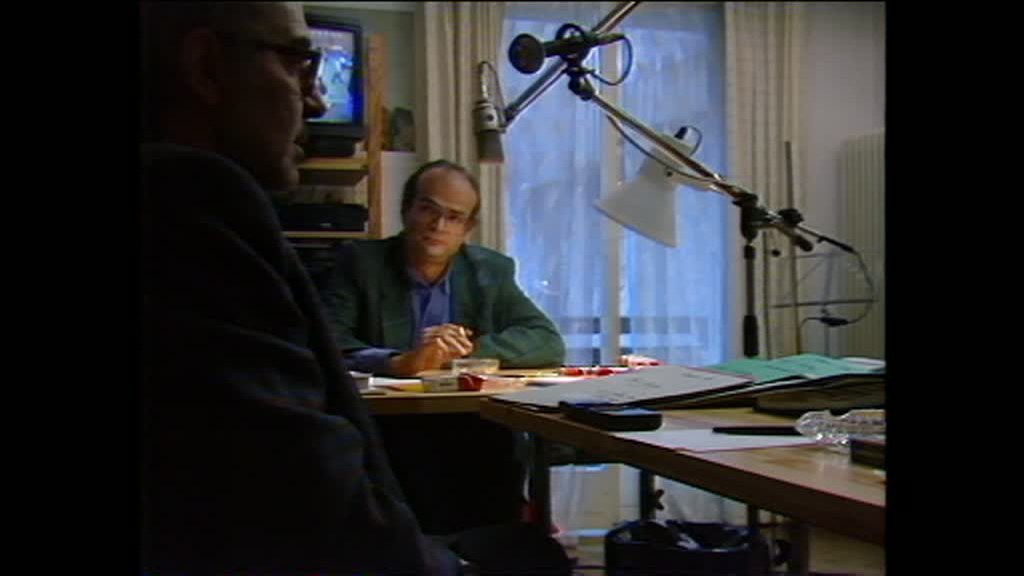
The video’s seven minutes consists of three shots: a wide shot of Godard standing in a room that might be his office, looking ragged, lighting a cigar and proceeding to recite a poetic farewell to the school of his own composition, and a medium shot and a close up from the same angle and camera position, separated by black during which we can hear Godard walk to the camera and zoom in. In typical Godardian font, the words “ADIEU” “AU” and “TNS” appear onscreen at various points. There is some mournful accordion-type music playing quietly in the background.
In the late 1990s, Godard attempted, as did his partner Anne-Marie Miéville, to secure an academic position in France. He looked for employment at La Fémis, a French filmmaking school, the Collège de France, and, most relevantly, the National Theater of Strasbourg. La Fémis was not interested in hiring Godard and his candidature for the Collège de France – aided by Pierre Bourdieu and Philippe Sollers – was denied. Having worked with several actors from the TNS while making For Ever Mozart (1996), including Bérengère Allaux (with whom he was evidently quite taken), Godard decided to contact Jean-Louis Martinelli, the director of the theater – which also, as mentioned above, had an acting school – to see if he could work with the school in some way. He proposed working with ten students in order so that he might learn about theater, and making a documentary film about the school. What exactly his work with the students involved is not entirely clear. It does not seem like he taught a class or a seminar, and, according to Godard’s own account, it would seem he never met the students in person (although Brody and de Baecque claim the students traveled to Rolle to visit Godard at his home).
第71届戛纳国际电影节颁奖典礼 (2018) [电影] 豆瓣
其它标题: The 71th Cannes International Film Festival / 第71届戛纳国际电影节
第71届戛纳国际电影节定于5月8日至19日在法国南部城市戛纳举行,澳大利亚影星、奥斯卡影后凯特·布兰切特将出任评委会主席。
东亚代表是枝裕和凭《小偷家族》摘得金棕榈奖。让-吕克-戈达尔《影像之书》获特别金棕榈,斯派克·李执导的《黑色党徒》获评委会大奖。Marcello Fonte凭借《犬舍惊魂》获得最佳男演员,萨玛尔-叶斯利亚莫娃则凭在《小家伙》中的出色表现获得最佳女演员。
和解之后 (2000) [电影] 豆瓣
Après la réconciliation
导演: 安娜-玛丽·米埃维尔 演员: 让-吕克·戈达尔 / 安娜-玛丽·米埃维尔
其它标题: Après la réconciliation / After the Reconciliation
兩個女人與兩個男人會面,彼此交談並提問,問答內容甚至包括遣詞用句的意涵,但主要是關於愛與幸福的人類基本話題。愛的和諧是否能和智慧與才智,恐懼與疲倦相互調和、共存?這四位知曉人生存在價值的男女,以幽默、嚴肅和愉悅之情,攜手共同尋找自己的路。在本片中,聰慧的女導演米耶維勒思考著情侶關係、智識的無趣和疲乏,以及語言的限制。透過四位人物,她將這些亙久以來的人生疑問如戲劇化的白日夢般呈現。這部影片也是一場哲學式的白日夢,談論著孤獨與劇場–也就是電影。 米耶維勒在本片中大量運用文學與哲學典故,如康拉德、海德格、雨果和托爾斯泰之名作或啟人深省的話語,不僅讓影片充滿溫暖與幽默,同時帶觀眾一探她自傳式的過往與哲學背景。本片的迷人之處,在於這齣沙發電影顯露的讓人困惑的處境和喜劇,以及逐漸發展成伴侶治療的後續結果。高達也演出其中一個要角Robert,帶著一貫的嘲諷和引經據典的習慣,比如他向一對雙眼閃爍幸福之光的情侶說:「希望你們不會指望愛能帶來幸福。」他與米耶維勒在片中有精彩的對手戲,米耶維勒難得的強硬姿態,從高達年邁啜泣的身影,到兩人相擁、重修舊好,彷彿是對兩人在現實世界關係的思考。 影片開始,米耶維勒以幾段拍攝孩童的家庭錄像影片說明本片拍攝的動機,然後以一個慢動作鏡頭拍攝米耶維勒身穿鬥牛服,在劇院鎂光燈下奮力揮動長鞭的挺拔身影。這個舞台風格化鏡頭的安排明顯帶有宣示的意味。直到本片的完成,米耶維勒才真正從高達這位導師與伴侶的庇護下走出,綻放個人耀眼的光采。本片確立她獨特原創的作者風格,著重在她特別擅長的演員調度、整合文字和音樂段落,以嚴肅的哲學、藝術式的提問重新安排敘事形式。這些電影有如米耶維勒的影像書寫,人類經驗的複雜面貌,透過細膩的攝影鏡頭與導演敏銳的感性,向觀者反射出無比動人的光采。
Paparazzi (1964) [电影] 豆瓣
导演: 雅克·罗齐耶 演员: Michel Piccoli / Brigitte Bardot
Paparazzi explores the relationship between Brigitte Bardot and groups of invasive photographers attempting to photograph her while she works on the set of Jean-Luc Godard's film Le Mépris (Contempt). Through video footage of Bardot, interviews with the paparazzi, and still photos of Bardot from magazine covers and elsewhere, director Rozier investigates some of the ramifications of international movie stardom, specifically the loss of privacy to the paparazzi. The film explains the shooting of the film on the island of Capri, and the photographers' valiant, even foolishly dangerous, attempts to get a photograph of Bardot.
无题8:随心所欲 (2022) [电影] 豆瓣
Sem Título #8: Vai Sobreviver
导演: Carlos Adriano 演员: 安娜·卡里娜 / 让-吕克·戈达尔
其它标题: Sem Título #8: Vai Sobreviver
A tribute to the actress Anna Karina (1940–2019) that picks up from her performance in Jean-Luc Godard’s My Life to Live (1962), the film that—back in 1982—would inspire the director Carlos Adriano to make (think, and live) movies. Editing began on sem título # 8 in 2016 and was completed in 2021. It unwittingly foreshadowed the symptoms of the Coronavirus pandemic (among other viruses). The film is part of the series Notes for an AutoCineBiography (in Regression).
法国新浪潮:一帮法外之徒 (2022) [电影] 豆瓣
La Nouvelle Vague, une bande à part
导演: Florence Platarets 演员: 让-吕克·戈达尔 / 弗朗索瓦·特吕弗
其它标题: La Nouvelle Vague, une bande à part / Die Nouvelle Vague, eine Außenseiterbande
In 1959, an unforgettable boy did "the four hundred tricks" in front of the camera of a beginner named François Truffaut and splashed with his success, popular and Cannes, the filmography of a nascent band of intrepid. Claude Chabrol's "Le Beau Serge", Jean-Luc Godard's "A bout de souffle", Jacques Rivette's "Paris nous appartient", Eric Rohmer's "Le Signe du lion", Jacques Rozier's "Adieu Philippine", Agnès Varda's "Cléo de 5 à 7"...: This wave, quickly named "New Wave" - an expression invented by Françoise Giroud in an article dedicated to youth - is the work of apprentice directors who, for many, have swallowed kilometers of film at Henri Langlois' Cinémathèque française and sharpened their judgment in the columns of Cahiers du cinéma.
Two American Audiences: La Chinoise - A Film in the Making (1968) [电影] 豆瓣
导演: Robert Leacock / D.A. Pennebaker 演员: 让-吕克·戈达尔 / Robert Leacock
其它标题: Un film en train de se fair
"Announcing itself as “a typical Pennebaker production of a typical Godard visit,” JLG speaks with grad students and Serge Losique at NYU in April 1968. Pennebaker: “When Jean-Luc Godard came to New York to make a film [1 A.M./1 P.M.] with me and Ricky Leacock, he was anxious to see America before the revolution broke out, torn up as it was with the Vietnam furor. Godard’s most recent film, La Chinoise, was playing, and Columbia University students, who had initiated their student uprising on the day the film opened, were pouring into the theater. This to our unexpected delight, for when Godard had arranged for us to distribute the film, we had done so with misgiving since his films were not normally known to fill theaters. So as we laughed at his sly remarks, it occurred to us that there were two audiences involved here, and maybe that our film should be about that. It might also be noted that the date of the filming, April 4, 1968, was the day Martin Luther King Jr. was killed. Of course, none of us in the room knew about that then."
Godard par Godard (2023) [电影] 豆瓣
导演: Florence Platarets 演员: 迪克·卡维特 / 让-吕克·戈达尔
其它标题: Godard by Godard
Godard by Godard is an archival self-portrait of Jean-Luc Godard. It retraces the unique and unheard-of path, made up of sudden detours and dramatic returns, of a filmmaker who never looks back on his past, never makes the same film twice, and tirelessly pursues his research, in a truly inexhaustible diversity of inspiration. Through Godard’s words, his gaze and his work, the film tells the story of a life of cinema; that of a man who will always demand a lot of himself and his art, to the point of merging with it.
巨匠再见 (2023) [电影] 豆瓣
Say God Bye
导演: 托马斯·因巴赫 演员: 让-吕克·戈达尔 / David Charap
其它标题: Say God Bye
“JLG is like a sun, as soon as you get too close to it, you burn. If you ignore it, you miss the light.” Respected Swiss director Thomas Imbach on the “God of Cinema” who, as both man and filmmaker, has kept him spellbound his whole life. Chancing upon images of the ailing grand master, he was inspired to set off on foot on a pilgrimage from Lakes Zurich to Geneva to pay tribute to Godard and to attempt to persuade the latter to film with him. An original and playful diary filmed on an iPhone and on 35mm during the trip, where loyal pilgrim Imbach looks back at his own career and conducts a dialogue with his magnetic role model. A road movie conceived – literally, “on his own two feet” – as an informed Godard masterclass about perceiving the world through cinema and much else besides.
源自:
戈达尔的影像 (2022) [电影] 豆瓣 TMDB
Godard seul le cinéma
导演: 西里尔·洛蒂 演员: 让-吕克·戈达尔 / 纪尧姆·谷伊
其它标题: 고다르 시네마 / Godard, seul le cinéma
我们相信戈达尔!
现代电影最具影响力的导演之一的故事,本着导演自己电影的精神分六章讲述,安娜卡琳娜等偶像也参与其中。 革命者、偶像破坏者、永恒的创新者。让-吕克·戈达尔 (Jean-Luc Godard) 是有史以来最激进、最焦躁不安的电影导演之一。去年去世时,他一生创作了 140 多部电影和视频,他是一位导演和现代电影艺术家的缩影,尽管他对电影历史的批判和解构比任何人都多。受人尊敬的法国电影评论家西里尔·洛伊西 (Cyril Leuthy) 以戈达尔的精神描绘了一幅肖像,分为六章,每一章的灵感都来自他一生工作的各个阶段。
巴黎人的香烟 (1992) [电影] 豆瓣
Parisienne People Cigarettes
导演: 让-吕克·戈达尔 Jean-Luc Godard 演员: 让-吕克·戈达尔
其它标题: Parisienne People Cigarettes
Godard and Miéville's 1992 contribution to a series of cigarette ads directed by prestigious filmmakers.
小戈达尔 (1978) [电影] 豆瓣
Der kleine Godard an das Kuratorium junger deutscher Film
导演: Hellmuth Costard 演员: 赫尔穆特·科斯塔尔 / Marie-Luise Scherer
其它标题: Der kleine Godard an das Kuratorium junger deutscher Film / Little Godard. To the Production Board for Young German Film
In Little Godard. To the Production Board for Young German Film, Hamburg’s experimental filmmaker Hellmuth Costard used a Super 8 film system he developed himself that allowed for numerous Super 8 cameras to be synchronised to each other during filming. “Power to Super 8!” was the cry before video cameras became ubiquitous, a low-cost solution for amateurs and even independent professional filmmakers. The content of the film is bookended by an application for a subsidy in which Costard formulates his objection to using the screenplay to evaluate a potential film project…