J.R.R. Tolkien — 作者 (252)
The History of the Lord of the Rings (The History of Middle-earth) [图书] 豆瓣
作者: J.R.R. Tolkien publishing house: Houghton Mifflin Co 2000 - 9
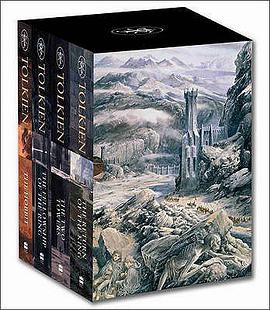
J.R.R. Tolkien's THE LORD OF THE RINGS, now firmly acknowledged as one of the most popular books of the twentieth century, has captivated generations of readers with its completely convincing fantasy. In The History of The Lord of the Rings, the author's son and literary heir, Christopher Tolkien, examines the creation of that epic from its inception to its finished form. At the core of these books are many early drafts and unpublished passages by Tolkien, which add greatly to a thorough understanding of his masterpiece. Combining his father's unique vision with his own privileged insight and editorial commentary, Christopher Tolkien's THE HISTORY OF THE LORD OF THE RINGS is a set of four volumes -- including one unique to this collection -- that no fan of THE LORD OF THE RINGS can afford to overlook.
The Book of Lost Tales, Part Two [图书] Goodreads 豆瓣
作者: Christopher Tolkien / J.R.R. Tolkien publishing house: HarperCollins 2010 - 3
<i>The Book of Lost Tales 2 (The History of Middle-Earth, Vol. 2)</i><br />viii, 391 pp. "The Book of Lost Tales was the first major work of imagination by J.R.R. Tolkien, begun in 1916, when he was twenty-five years old, and left incomplete several years later. It stands at the beginning of the entire conception of Middle-earth and Valinor, for the Lost Tales were the first form of the myths and legends that came to be called The Silmarillion. Embedded in English legend and association, they are set in the narrative frame of the great westward voyage of a mariner named Eriel (or AElfwine). His destination is Tol Eressea, the Lonely Isle where Elves dwell; from them he learns their true history, the Lost Tales of Elfinesse. The Tales include the earliest accounts of Gods and Elves, Dwarves, Balrogs, and Orcs; of the Silmarils and the Two Trees of Valinor; of Nargothrond and Gondolin; of the geography and cosmography of their invented world. The Book of Lost Tales is published in two volumes. The first contains the Tales of Valinor; and this second past includes Beren and Luthien, Turin and the Dragon, and the only full narratives of the Necklace of the Dwarves and the Fall of Gondolin. Each tale is followed by a commentary, together with associated poems, and each volume contains extensive information on names and vocabulary of the earliest Elvish languages. Additional books in this series will extend the history of Middle-earth as it was refined and enlarged in later years and will include the long Lays of Beleriand, the Ambarkanta or Shape of the World, the Lhammas or Account of Tongues, annals, maps, and many other previously unpublished writings of J.R.R. Tolkien."Keywords: FANTASY SCIENCE FICTION HISTORY MIDDLE EARTH JRR TOLKIEN BOOK OF LOST TALES
The Lays of Beleriand (The History of Middle-Earth, Vol. 3) [图书] 豆瓣
作者: J.R.R. Tolkien publishing house: Houghton Mifflin 1985 - 11
This is the third volume of the History of Middle-earth, which comprises here-tofore unpublished manuscripts that were written over a period of many years before Tolkien's Simlarillion was published. Volumes 1 and 2 were the Book of Lost Tales, Part One and The Book of Lost Tales, Part Two. Together, these volumes encompass an extraordinarily extensive body of material ornamenting and buttressing what must be the most fully realized world ever to spring from a single author's imagination.
"I write alliterative verse with pleasure," wrote J.R.R. Tolkien in 1955, "though I have published little beyond the fragments in The Lord of the Rings, except The Homecoming of Beorhtnoth." The first of the poems in The Lays of Beleriand is the previously unpublished Lay of the Children of Hurin, his early but most sustained work in the ancient English meter, intended to narrate on a grand scale the tragedy of Turin Turambar. It was account of the killing by Turin of his friend Beleg, as well as a unique description of the great redoubt of Nargothrond.
The Lay of the Children of Hurin was supplanted by the Lay of Leithian, "Release from Bondage", in which another major legend of the Elder Days received poetic form, in this case in rhyme. The chief source of the short prose tale of Beren and Luthien is The Silmarillion.
This, too, was not completed, but the whole Quest of the Silmaril is told, and the poem breaks off only after the encounter with Morgoth in his subterranean fortress. Many years later, when The Lord of the rings was finished, J.R.R. Tolkien returned to the Lay of Leithian and started on a new version, which is also given in this book.
Accompanying the poems are commentaries on the evolution of the history of the Elder Days, which was much developed during the years of the composition of the two Lays. Also included is the notable criticism in detail of the Lay of Lethian by C.S. Lewis, Tolkien's friend and colleague, who read the poem in 1929. By assuming that this poem is actually a fragment from a past lost in history, Lewis underlined the remarkable power of its author's imaginative talents and academic competence.
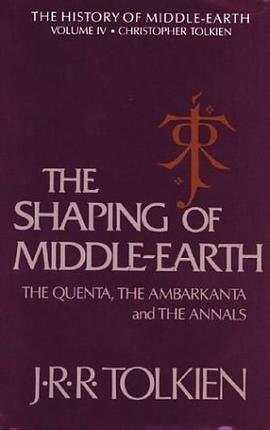
The Shaping of Middle-Earth [图书] 豆瓣
作者: J.R.R. Tolkien publishing house: Houghton Mifflin 1986 - 11
This is the fourth volume of The History of Middle-earth, edited by Christopher Tolkien, the first two comprising The Book of Lost Tales Parts One and Two, and the third The Lays of Beleriand.
It has been given the title The Shaping of Middle-earth because the writings it includes display a great advance in the chronological and geographical structure of the legends of Middle-earth and Valinor. The hitherto wholly unknown "Ambarkanta," or Shape of the World, is the only account ever given of the nature of the imagined Universe, and it is accompanied by diagrams and maps of the world before and after the cataclysms of the War of the Gods and the Downfall of Numenor. The first map of Beleriand, in the North-west of Middle-earth, is also reproduced and discussed. In the "Annals of Valinor" and the "Annals of Beleriand" the chronology of the First Age is given shape; and with these are given the fragments of the translations into Anglo-Saxon made by Aelfwine, the Englishman who voyaged into the True West and came to Tol Eressea, the Lonely Isle, where he learned the ancient history of Elves and Men.
Also included are the original "Silmarillion," written in 1926, from which all the later development proceeded, and the "Quenta Noldorinwa" of 1930, the only version of the myths and legends of the First Age that J.R.R. Tolkien completed to their end. As Christopher Tolkien continues editing the unpublished papers that form the bedrock from which The Lord of the Rings and The Silmarillion were quarried, the vastness of his father's accomplishment becomes even more extraordinary.
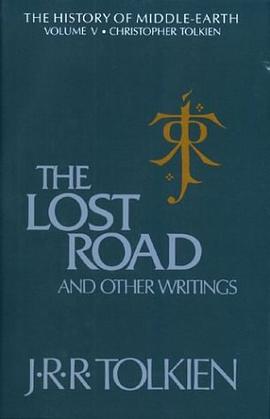
The Lost Road and Other Writings (The History of Middle-Earth, Vol. 5) [图书] 豆瓣
作者: J.R.R. Tolkien publishing house: Houghton Mifflin 1987 - 11
At the end of the 1937 J.R.R. Tolkien reluctantly set aside his now greatly elaborated work on the myths and heroic legends of Valinor and Middle-earth and began The Lord of the Rings. This fifth volume of The History of Middle-earth, edited by Christopher Tolkien, completes the presentation of the whole compass of his writing on those themes up to that time. Later forms of the Annuals of Valinor and the Annals of Berleriand had been composed, The Silmarillion was nearing completion in a greatly amplified version, and a new map had been made; the myth of the Music of the Ainur had become a separate work; and the legend of the Downfall of Numenor had already entered in a primitive form, introducing the cardinal ideas of the World Made Round and the Straight Path into the vanished West.
Closely associated with this was the abandoned time-travel story, The Lost Road, which was to link the world of Numenor and Middle-earth with the legends of many other times and peoples.
A long essay, The Lhammas, had been written on the ever more complex relations of the languages and dialects of Middle-earth; and an etymological dictionary had been undertaken, in which a great number of words and names in the Elvish languages were registered and their formation explained - thus providing by far the most extensive account of their vocabularies that has appeared.
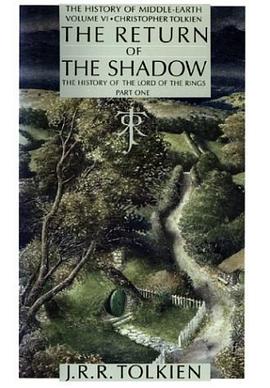
The Return of the Shadow [图书] 豆瓣
作者: J.R.R. Tolkien publishing house: Houghton Mifflin 1989 - 1
In this sixth volume of The History of Middle-earth the story reaches The Lord of the Rings. In The Return of the Shadow (an abandoned title for the first volume) Christopher Tolkien describes, with full citation of the earliest notes, outline plans, and narrative drafts, the intricate evolution of The Fellowship of the Ring and the gradual emergence of the conceptions that transformed what J.R.R. Tolkien for long believed would be a far shorter book, 'a sequel to The Hobbit'. The enlargement of Bilbo's 'magic ring' into the supremely potent and dangerous Ruling Ring of the Dark Lord is traced and the precise moment is seen when, in an astonishing and unforeseen leap in the earliest narrative, a Black Rider first rode into the Shire, his significance still unknown. The character of the hobbit called Trotter (afterwards Strider or Aragorn) is developed while his indentity remains an absolute puzzle, and the suspicion only very slowly becomes certainty that he must after all be a Man. The hobbits, Frodo's companions, undergo intricate permutations of name and personality, and other major figures appear in strange modes: a sinister Treebeard, in league with the Enemy, a ferocious and malevolent Farmer Maggot.
The story in this book ends at the point where J.R.R. Tolkien halted in the story for a long time, as the Company of the Ring, still lacking Legolas and Gimli, stood before the tomb of Balin in the Mines of Moria. The Return of the Shadow is illustrated with reproductions of the first maps and notable pages from the earliest manuscripts.
The Peoples of Middle-Earth (The History of Middle-Earth, Vol. 12) [图书] 豆瓣
作者: J.R.R. Tolkien / Christopher Tolkien publishing house: Houghton Mifflin 1996
Throughout this vast and intricate mythology, says Publishers Weekly, "one marvels anew at the depth, breadth, and persistence of J.R.R. Tolkien's labor. No one sympathetic to his aims, the invention of a secondary universe, will want to miss this chance to be present at the creation." In this capstone to that creation, we find the chronology of Middle-earth's later Ages, the Hobbit genealogies, and the Western language or Common Speech. These early essays show that Tolkien's fertile imagination was at work on Middle-earth's Second and Third Ages long before he explored them in the Appendices to The Lord of the Rings . Here too are valuable writings from Tolkien's last years: " The New Shadow," in Gondor of the Fourth Age, and" Tal-elmar," the tale of the coming of the Nœmen-rean ships.