War over Words [图书] 豆瓣
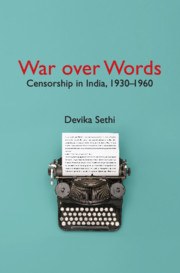
Censorship has been a universal phenomenon through history. However, its rationale and implementation have varied, and public reaction to it has differed across societies and times. In this book I recover, narrate, and interrogate the history of censorship of publications in India over three crucial decades—encompassing the Gandhian anti-colonial movement, the Second World War, Partition, and the early years of independent India. In doing so, I examine state policy and practice, as also its subversion, in a tumultuous period of transition from colonial to self-rule in India. Populated with an array of powerful and powerless individuals, the story of Indians grappling with free speech and (in)tolerance is a fascinating one, and deserves to be widely known.
Drawing upon a range of sources as diverse as the banned material itself, legal judgments, legislative debates, memoirs and biographies, contemporary newspaper reports and letters to editors, government papers and reports, first-person accounts, and empirical and theoretical works by scholars of censorship across the world, I focus attention both on censors and the censored. I explore the diverse mechanisms and motivations for censorship and its role in the shaping of the modern Indian republic.
Drawing upon a range of sources as diverse as the banned material itself, legal judgments, legislative debates, memoirs and biographies, contemporary newspaper reports and letters to editors, government papers and reports, first-person accounts, and empirical and theoretical works by scholars of censorship across the world, I focus attention both on censors and the censored. I explore the diverse mechanisms and motivations for censorship and its role in the shaping of the modern Indian republic.