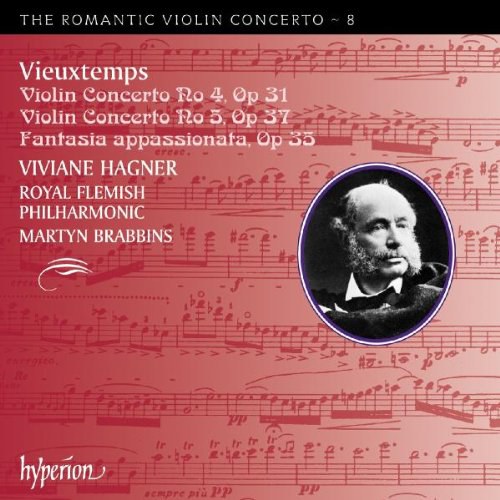
Hyperion’s Romantic Violin Concerto series reaches volume 8 and the music of the Belgian composer Henry Vieuxtemps, himself widely considered the finest violinist in Europe after the death of Paganini. Listening to the repertoire recorded here, he certainly deserves to be ranked among the most important composers for the violin in the mid-nineteenth century. Vieuxtemps never indulged in sheer virtuosity for its own sake; instead in his concertos and chamber works he brought a more classical dimension to the violin repertoire in place of the technically brilliant variations and fantasies on popular operatic themes that were so popular with audiences.
The Violin Concerto No 4 in D minor, Op 31, which Vieuxtemps composed while he was court violinist in St Petersburg, is an heroic work on a substantial scale. It was described by Berlioz—who was perhaps comparing it with his own Harold in Italy for viola and orchestra—as a symphony with violin solo. In fact Vieuxtemps’s writing for the orchestra is as assured and resourceful, and sometimes as imaginative, as his treatment of the violin, though there is no doubt that the solo instrument remains the leading actor in the drama, reaching heights of stratospheric virtuosity throughout. Violin Concerto No 5 in A minor, Op 37, was written a few years later, in 1858–9, at the request of his friend Hubert Léonard, as the test-piece for a competition at the Brussels Conservatory. The work was, therefore, expressly designed to test the capabilities of (very advanced) student players, but it has maintained itself in the repertoire on its own merits and probably surpasses the Fourth Concerto in popularity. Fantasia appassionata, Op 35, was probably written shortly after the Fifth Violin Concerto, in 1860. Unlike the concertos this is more frankly a vehicle for transcendental technical display, but expertly cast in a single movement of several effectively contrasted sections that achieves a balanced form as well as the exhibition of the player’s prowess.
The young virtuoso Viviane Hagner, a former BBC New Generation artist, acclaimed for her highly intelligent musicality and passionate artistry, appears in her Hyperion debut.
Widely considered the finest violinist in Europe after the death of Paganini, the Belgian Henry Vieuxtemps was born in 1820 in Verviers, not far from Liège. He had his first lessons from his father, a weaver and amateur violin-maker, and then from a renowned teacher, Lecloux-Dejonc. He made his concert debut at the age of six and toured neighbouring cities with his teacher, attracting the attention of the noted violinist-composer Charles de Bériot in the process. Two years later he went to Brussels to study with de Bériot, who introduced Vieuxtemps to Parisian audiences in 1829 with great success. After de Bériot’s teaching ended in 1831, his sister-in-law (the singer, pianist and composer Pauline Garcia, herself a pupil of Liszt) also assisted in Vieuxtemps’s continuing musical education. After giving a series of concerts in Germany and Austria—winning praise from Robert Schumann, who heard him in Leipzig—Vieuxtemps made his debut in London in 1834, where he also heard and met Paganini.
Vieuxtemps was anxious to perfect his technique and broaden his musical tastes, but seems to have picked up a lot of his skill in composition piecemeal as he embarked on the busy, country-hopping career of a travelling virtuoso. In Vienna—where he was the first to revive Beethoven’s Violin Concerto—he took composition lessons from Simon Sechter (with whom Schubert had studied in the last months of his life), and in Paris from Antoine Reicha. The first of his seven violin concertos—later published as Concerto No 2—dates from this time. Vieuxtemps went on to visit Russia for the first time in 1837, and he toured America in 1843 and 1844. In the latter year he married the Vienna-born pianist Josephine Eder, and in 1846 settled for some years in St Petersburg as court violinist and soloist in the Imperial Theatres as well as teaching violin at the Conservatory. He left a lasting legacy there, for he had a definite influence on the development of the Russian school of violin playing. In 1854 the leading Viennese critic Eduard Hanslick ranked Vieuxtemps together with Joseph Joachim as the two foremost violinists in the world.
After a second American tour in 1857 with the great pianist-composer Sigismond Thalberg, and further periods based successively in Brussels, Frankfurt and Paris, Vieuxtemps returned to Brussels in 1871 as professor of violin at the Brussels Conservatoire, where his most celebrated pupil was Eugène Ysaÿe. His career as a virtuoso was cut short by a stroke that affected his bowing arm, but though he was acutely frustrated by his inability to perform to his former standard, Vieuxtemps managed to resume conducting and teaching until 1879, when he resigned from the Conservatoire and joined his daughter and son-in-law in Algeria. Here he completed his last two violin concertos before his death on 6 June 1881; his body was brought back to Belgium and he was buried with honours in his home town of Verviers.
Almost all Vieuxtemps’s works involve the violin, whether in orchestral or chamber music, though there are two cello concertos and a significant group of works for the viola, which he played equally well (in fact, though generally thought of as a virtuoso soloist, he was an enthusiastic performer of chamber music, in which he often took the viola role). He certainly deserves to be ranked among the most important composers for the violin in the mid-nineteenth century. Vieuxtemps never indulged in sheer virtuosity for its own sake; instead, in his concertos and chamber works he brought a more classical dimension to the violin repertoire in place of the technically brilliant variations and fantasies on popular operatic themes that were so popular with audiences.
Vieuxtemps’s personal favourite among his concertos was the Violin Concerto No 4 in D minor Op 31, which he composed while he was court violinist in St Petersburg. A heroic work on a substantial scale, it was described by Berlioz—who was perhaps comparing it with his own Harold in Italy for viola and orchestra—as a symphony with violin solo. In fact Vieuxtemps’s writing for the orchestra is as assured and resourceful, and sometimes as imaginative, as his treatment of the violin, though there is no doubt that the solo instrument remains the leading actor in the drama.
Nevertheless, Vieuxtemps delays its first appearance for a considerable length of time. The Andante first movement opens quietly, almost mystically, in the manner of a chorale. This is only the beginning of an extended and deeply expressive introduction that stealthily gathers pace, fills out in orchestration, and briefly turns turbulent and tempestuous, only to subside into a solemn march-rhythm and a swirling ostinato-figure in the strings that suggests billowing clouds. The soloist finally enters at stratospheric heights, and launches into a voluble, dramatic expostulation, assisted by the orchestra. A lyrical contrasting theme, Moderato, completes the roster of the movement’s material, whereupon the soloist launches into a passionate cadenza featuring fearsome triple- and quadruple-stopping.
A brief, swaggering cadential passage fades out on a long-held horn note that provides a link to the second movement, Adagio religioso. This too begins with a chorale-like idea, in the woodwind; and the violin’s first entry is largely concerned to decorate and extend this idea in a vein of warm sentiment. Ardour and virtuosity are not far away, however, and the movement turns dramatic for a while. When the passions subside we find the violin in a chaste duet with a harp, as it revisits the pieties of the movement’s opening, rising to a brief pinnacle of ecstasy before the close.
Vieuxtemps gave his performers the option of omitting the next movement, Vivace, but that course is not taken on this disc. It is a full-scale scherzo (in D minor) and trio (in D major), the former largely based on the violin’s opening theme in skittish dactylic rhythm. The scherzo’s deft, swooping phrases form the backbone for a remarkable bout of pyrotechnic virtuosity. The central trio is more rustic in character, with drone fifths in the orchestra and hunting-horn thirds and sixths in the solo part that are taken up and imitated by the horns themselves. After the reprise of the scherzo a scintillating coda brings this brilliant movement to an end.
Vieuxtemps calls his last movement Finale marziale. It begins with a review of the material of the first movement by the orchestra alone, thus allowing the soloist a much-needed rest—which is prolonged as the orchestra launches into the festive march-tune that is the finale’s main focus. The soloist re-enters, and soon takes over the march-tune, though in a good-humoured and less than military manner. Hair-raising fusillades of triple-stopping and trills punctuate the recurrences of the march, and as the end is approached the violin indulges in ever more breathtaking prodigies of bravura right up to the concluding bars.
Vieuxtemps’s Violin Concerto No 5 in A minor Op 37 was written a few years later, in 1858–9, at the request of his friend Hubert Léonard, as the test-piece for a competition at the Brussels Conservatory, where Léonard was professor of violin (the post that Vieuxtemps himself would later occupy). The work was, therefore, expressly designed to test the capabilities of (very advanced) student players, but it has maintained itself in the repertoire on its own merits and probably surpasses the Fourth Concerto in popularity. It is sometimes known as the ‘Grétry’ Concerto because Vieuxtemps chose to quote a melody of that composer in the Adagio. Originally there was no slow movement, only the first movement and finale linked by a cadenza, but Vieuxtemps eventually added the Adagio in the interests of structural balance and range of expression. Essentially, however, the concerto is played without a break as if in a single movement (an idea that Vieuxtemps may have derived from the piano concertos of Liszt or the Concerto pathétique of Ernst).
A finely sculpted orchestral introduction exploits the ‘tragic’ possibilities of the A minor tonality to set out three powerful and memorable themes, then subsides into relative stasis as if becalmed. The violin first enters with reflective rising arpeggios, but is soon giving vent to full-blooded virtuoso writing before it bends to the matter in hand, developing the substance of the orchestra’s exposition as an anxious first subject. A transition of brilliant passage-work leads to a yearningly lyrical second subject in C major. A passionate development ensues with the violin taking the lead in soloistic pyrotechnics, followed by a fairly orthodox recapitulation and coda save that the violin continues to expatiate against this background in its most flamboyant vein.
The orchestra breaks off for the cadenza, which begins with the opening theme of the work but develops into a magnificent polyphonic meditation, by no means simply a display piece, upon the first movement’s materials. A few bars of orchestra link into the Adagio, in which the violin first sings an almost operatic solo against a hushed pizzicato accompaniment. It modulates to C major to sing a hauntingly beautiful melody, adapted by Vieuxtemps from the aria ‘Où peut-on être mieux qu’au sein de sa famille?’ in André Grétry’s opera Lucille. After various episodes of touching pathos (here, as throughout, Vieuxtemps’s plangent scoring for woodwind is noteworthy), the ‘Grétry’ melody appears transfigured in A major, and the orchestra then hurries us into the A minor finale. Marked Allegro con fuoco, this is more of a bravura coda than a movement in its own right, a brief effusion alluding to the themes of the first movement while hurrying us to a triumphant close.
Vieuxtemps’s Fantasia appassionata Op 35 was probably written shortly after the Fifth Violin Concerto, in 1860. Unlike the concertos this is more frankly a vehicle for transcendental technical display, but expertly cast in a single movement of several effectively contrasted sections that achieves a balanced form as well as the exhibition of the player’s prowess. The overall tonality of the piece is G, beginning in the minor mode and ending in the major. The opening, Allegro moderato, is stern and dramatic, the soloist first playing in unison with the orchestral violins and then breaking out in an impassioned dialogue with the orchestra. The ensuing Andante (from 1'58") balances this first section with pathos and graceful melody, before the turbulent mood returns briefly to make a transition to a new section, Moderato (starting at 3'48").
Here the tonality changes to G major, for a sweetly sentimental song in ballad-style from the violin, con grazia and molto espressivo. Vieuxtemps follows this (at 5'46") with a section headed ‘Variation’, which is a much-elaborated and decorated version of the Moderato theme, becoming increasingly florid as the music continues. An intervening orchestral tutti recalls the music of the work’s opening before (at 8'15") we move into a B major Largo section. Here the violin rhapsodizes ecstatically on a new, romantically inclined melody, with Poco più mosso orchestral rumblings in the middle which provoke the soloist to new prodigies of gypsy-style virtuosity. A tranquil return to the Largo theme carries the solo line to stratospheric heights before (at 13'32") the Finale section abruptly breaks in. Vieuxtemps terms this a Saltarella, and the impulsive, insouciant rhythm of the Italian dance proves the perfect vehicle for him to throw every possible challenge in the way of his interpreter. The effect is to dissipate the conflicting passions of the previous parts of the Fantasia in merriment and good-fellowship, but with the violin claiming the admiration of all for its dumbfounding exhibition displays of technical prowess.
Calum MacDonald © 2010