Review
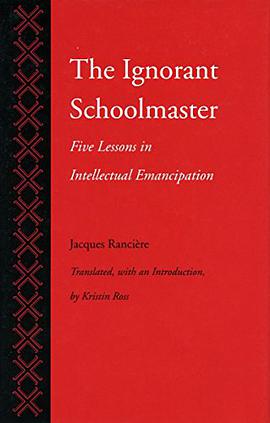
'An extremely provocative, original, and engaging book, it raises questions of great relevance and urgency about the process of cultural selection and canonization.'Denis Hollier, Yale UniversityIgnorant Schoolmaster
In The Ignorant Schoolmaster, Rancière uses the historical figure of Joseph Jacotot as a way of discussing human nature, education, pedagogy, ignorance, intelligence, and emancipation. These ideas have profound implications on the nature of schooling and research, and the role that teachers and scholars play. Contents [hide]
1 Joseph Jacotot (1770-1840)
2 Explication
3 Emancipation
4 Ignorance
5 Intelligence
6 Will
7 Language
[edit]
Joseph Jacotot (1770-1840)
Jacotot was a French instructor who taught subjects as far-ranging as French, literature, mathematics, ideology and law (p. 1). He had a profound realization one time when he had to teach a group of Flemish students French. Since he didn’t know Flemish himself, he had the challenge of teaching these students French.
[edit]
Explication
The conventional view of the teacher’s (or master’s, as Rancière calls it), is to “explicate”. But Jacotot noticed that his Flemish students were able to learn French without any explication from him. He had given them a bilingual text of Télémaque; using that, his students were able to eventually under French grammar and spelling, using a text that was aimed for adults, and not “simplified” for school children. Jacotot (or maybe Rancière?) was inspired to ask: Were schoolmaster’s explications superfluous? (p. 4) Rancière believes that explication stultifies learning by short-circuiting the journey that the student is able to make. Teachers who rely on explication inadvertently creates a “veil of ignorance” (p. 6) what the student is expected to learn, thus creating a world of superior (i.e. the master, the explicator) and inferior (i.e. the student, the ignorant). But Rancière believes that all people are capable of learning without explication because they have all acquired their mother tongues without explication (p. 5, 10). They learn, imitate, and correct themselves, and universally, all children will grow up to understand their parents without every spent one day in school. Why do we presume this intelligence goes away?
[edit]
Emancipation
Rancière distinguishes between two human traits: intelligence and will. In Jacotot’s classroom, there are two wills (the students’ and Jacotot’s) and two intelligences (the students’ and the book’s). Students may need to follow the teacher’s will, who guides them towards the subject. But stultification occurs when the students’ intelligences are linked with the teacher’s, when they have to rely on the schoolmaster to explain what they have learned. The opposite of stultification is, therefore, emancipation. But who emancipates? Once again, conventionally, it is the scholar, the philosopher, the wise, the learned, the Teachers College doctoral student. But Rancière believes that the only way to emancipate is when an intelligence obeys only itself even if its will obeys another’s will (p. 13). In reality, universal teaching has existed since the beginning of the world, alongside all the explicative methods...Everyone has done this experiment a thousand times in life, and yet it has never occurred to someone to say to someone else: I’ve learned many things without explanations, I think that you can too... (p. 16)In Jacotot’s class, the students learned using their own methods, not his. And in the end, they learned French, and they have done so using the oldest method in the world: universal teaching.
[edit]
Ignorance
Rancière argues that the “Socratic Method” is a perfected form of stultification, where the role of the Master is to interrogate (demand speech) and verify that intelligence is done with attention (p. 29). Even if these pedagogies are aimed at “empowering” the student, it is still done so after the master has verified it. Thus, it is still the master’s method, not the student’s.
The ignorant schoolmaster does not verify what the student has found, only that the student has searched (p. 31). This means that anyone, including illiterate parents, can teach their children how to read and write. For example, they can question whether they pronounce the same word each time in the same way, or hide it under their hand and ask the student what is under it. This is true not only for re
[edit]
Intelligence
Most people become stultified because they believe in their inferiority (p. 39). And superior minds can only be superior if they can make everyone else inferior. Thus we never break out of that circle, not matter how generous our intentions may be. The word intelligence is often understood as a number, or variable, that describes different people’s capacities to comprehend complex ideas or solve logic problems. But Rancière believes that everyone has the same intelligence (p. 50). He argues that a statement like “Bob is smarter because he produces better work” is a tautological statement that explains nothing. It’s true that people will produce different types of work, but he doesn’t see this as the result of different intelligence, but as a result of not bringing sufficient attention to the work.
[edit]
Will
Intelligence has to do with attention while will has to do with the “power to be moved” (p. 54). Rancière argues that each of us represents a will that is served by an intelligence. We see, analyze, compare, reason, correct, reconsider, on an everyday basis. We do not always learn the same things because we do not pay the same amount of attention to the situation. Furthermore, he suggests that “[m]eaning is the work of the will” (p. 56). He calls “secret” of universal teaching, something that geniuses all know. All humans are capable of anything they want.
[edit]
Language
Jacotot/Rancière believed that truth cannot be told. When it is expressed in language it becomes fragmented (p. 60). Hence, he goes into the arbitrariness of language to suggest that there is no language that is superior than others because they are equally arbitrary. Intelligence does not have a language. As Jacotot argued, we are not intelligent because we speak; we are intelligent because we exist. But this is not a problem. It is precisely because all languages are arbitrary that we employ all we have access to (including but not limited to language) in expressing truth. (p. 62) Rancière calls our expression through language as a form of art, like improvisation. He calls “telling the story” and “figuring things out” the two master operations of intelligence (p. 64). He believes that the artist is the exact opposite of the professor. He argues: “Each one of us is an artist to the extent that he carries out a double process; he is not content to be a mere journeyman but wants to make all work a means of expression, and he is not content to feel something but tries to impart it to others” (p. 70).