This volume has been compiled as a tribute to a scholar who has devoted his prodigiously productive career to the study of Chinese and Sino-Tibetan linguistics: W. South Coblin. To honor this man whose depth and range of scholarly interests and accomplishments are nothing short of awe-inspiring, and whose influence on the field is broad and powerful, on the occasion of his seventieth birthday we have gathered together a collection of studies that speak to those interests in various ways and that also provide new and diverse contributions to the field.
South Coblin (known in Chinese as Kē Wèinán 柯蔚南) has exerted a profound impact on the field of Chinese and Sino-Tibetan linguistics as a researcher, teacher, mentor, and colleague. His career thus far has spanned over four decades, and his research has touched upon areas as varied as Sino-Tibetan comparative and historical linguistics, Chinese historical phonology, Chinese historical and comparative dialectology, Classical Chinese grammar, Old Tibetan, the language of early Chinese vernacular texts, the history and development of Chinese koines and pre-modern Mandarin, Chinese transcriptions in 'Phags-pa script, and most recently, in Korean. He has written groundbreaking and seminal studies in all of these fields, and many of his published works have become essential references. At present writing, he is author of eleven monographs and over eighty articles and book chapters, and these numbers will surely continue to grow. After this introduction appears a brief biography that gives an overview of South Coblin’s scholarly career and traces the trajectory of development of his many and various interests and projects, and this in turn is followed by a complete bibliography of his publications to date.
Among the twenty-three contributors to this volume are South Coblin’s graduate school classmates, colleagues and peers in the field, and students and others he has mentored. In gathering the papers we endeavored to assemble a selection of research that reflects the diversity of South’s scholarship and that engages with his scholarly interests. The resulting compilation comprises twenty-two papers, which have been arranged topically into five sections: Chinese historical linguistics, Chinese dialects, Tibetan and Tibeto-Burman, language contact and transcription, and texts and written Chinese. Each section corresponds to an area in which South Coblin himself has engaged in research, and thus the collection as a whole reflects the breadth of his scholarship. Many papers are at the forefront of their respective fields, and build on South’s earlier work to arrive at significant new conclusions.
The opening section of this volume, “Chinese Historical Linguistics,” represents the area in which South Coblin began his scholarly career, and the first paper was written by the late Professor Jerry Norman, the scholar who perhaps had the deepest influence on his scholarly work. Norman’s “A Model for Chinese Dialect Evolution” is a distillation of ideas he developed over the years, many in conversations with South, and provides an alternative model for the comparative study of Chinese dialects, a model that we anticipate will ultimately supersede and replace the conventional approach of relying primarily on the phonological categories of the Qièyùn 切韻. Norman outlines two historical stages of Chinese, Common Dialectal Chinese (CDC) and Early Chinese (EC), which he developed using a strictly comparative approach based entirely on observable and documented dialect data. In his paper, he deliberately eschews the incorporation of distinctions supported only by written evidence, which might be artifacts of the literary tradition, and without basis in the actual spoken dialects. He intended that CDC and EC would provide an objectively realistic framework for understanding Chinese linguistic evolution and the phonological development of the Chinese dialects, one from which the modern dialectal forms of Chinese could be easily and naturally derived. Jerry Norman had discussed many of the details of this work with South Coblin, and thus decided to contribute it to this volume as a tribute to his close friend. He sent the final version to the editors just twelve days before his death on July 7, 2012.
The next two papers in this section address other aspects of Chinese language history. Ho Dah-an’s study, “Phonological Problems in Imperial Naming Taboos” (史諱中的音韻問題) presents an examination of Chén Yuán’s 陳垣 1928 Examples of Imperial Naming Taboos 史諱舉例 and, following a brief critique, explores the issue of taboo names and their relationship to Chinese phonological history. Ho’s discussion underscores the importance of historical phonology in any examination of issues bearing on Chinese linguistic history. Through a demonstration of the ways in which changes in the language affect the particularities of which graphs were taboo at different periods, Ho shows that once we obtain a clear understanding of the pertinent phonological issues, we may find that ostensible errors or exceptions to expected practice were not in fact departures from regular convention. Ting Pang-Hsin’s contribution, “A Comparative Study of Frequently Used Action Verbs in Hàn and Táng-Sòng Times” (漢與唐宋兩代若干常用動作動詞的比較), seeks clues to trends in Chinese lexical change through an examination of frequently used action verbs in Hàn times, as glossed in Xǔ Shèn’s許慎 Shuōwén jiězì 說文解字, and through comparison of the Hàn vocabulary with the Táng-Sòng lexicon as recorded in the complete editions of Wáng Rénxù’s 王仁昫 Kānmiù bǔquē Qièyùn 刊謬補缺切韻and the Guǎngyùn 廣韻. Ting concludes that overall, the Chinese lexicon shows a strong trend toward continuity, and consequently was only minimally influenced by other neighboring language families.
The second section, “Chinese Dialects,” comprises five essays that explore Chinese dialects from historical and descriptive perspectives. The first three papers examine various issues related to initials in dialect phonology. William H. Baxter’s “Northern Mǐn ‘Softened’ Initials in Borrowed Vocabulary” presents evidence for early Mandarin influence on southern dialects, arguing that the softened initials in the Northern Mǐn dialects have two origins. One appears in a set of words native to the dialects and originating very early therein; the other occurs in a set of words forming a borrowed literary stratum that the author’s analysis shows entered the Mǐn dialects from an early form of Mandarin. This early form of Mandarin would have been a southern type that retained the voiced obstruents of Middle Chinese. The second paper, by Zhongmin Chen, “On the Relationship between Tones and Initials of the Dialects in the Shànghǎi Area,” analyzes the correlation between tones and initials in the Shànghǎi region dialects. Chen first looks at the general relationship between tones and various types of initials, and then proceeds to examine a specific set of issues regarding the nature of voiceless stops followed by vowels with breathy phonation. These issues include the relationship between stops and tones, the influence of aspirated stops on tones, and the nature and distribution of pre-glottalized stops. Chen demonstrates that aspiration is a factor in the split of tone categories into different tone values and in the development of new tone categories owing to the influence of the initial type. The evolution of initials is also the subject of the next paper, “A Study of Diachronic Evolution and Age Variation in the Three Initials Groups of Zhī, Zhuāng and Zhāng in Nánjīng Dialect” (南京方言知莊章三組歷時演變與年齡差異研究), by Gù Qián 顧黔 and Zhāng Zhìlíng 張志凌. Gù and Zhāng examine the distribution in Nánjīng dialect of retroflex affricate initials [tʂ, tʂh, ʂ] and dental sibilant initials [ts, tsh, s] that reflect the three Qièyùn initial groups identified in the title. They conclude that variation in the distribution of the two groups of initials correlates to speaker age. Their paper explores the reasons for this age variation and investigates the course and diachronic direction of the evolution of the differing distribution of these groups of initials.
The final two articles of this section examine dialect phonologies from a broader perspective. Chāng Méixiāng’s昌梅香contribution, “A Homophone Syllabary of the Yúnlóu Dialect in Jí’ān County, Jiāngxī Province” (江西吉安縣雲樓方言同音字彙) presents primary dialect data. Her report describes the phonological system of the dialect spoken in Yúnlóu 雲樓 in Jí’ān County, Jiāngxī and provides an extensive syllabary of homophonous morphemes. Chāng was a recent visiting scholar at the University of Iowa, and during extensive discussions with South Coblin about this dialect material, he encouraged her to make data set available for scholarly reference. The last paper of the section investigates a dialect data source that dates back to the Qīng period. In “A Comparative Look at Common Southern Jiāng-Huái and the Southern Mandarin Influences in Hé Xuān’s Yùnshǐ,” Richard VanNess Simmons examines the phonology presented in the Yùnshǐ 韻史 (History of Rimes) compiled by Hé Xuān 何萱 (1774-1841). Hé Xuān, a native of Tàixīng 泰興 and Rúgāo 如皋 Counties in Jiāngsū 江蘇, revised the traditional Qièyùn system of initials to accord more closely with the dialects of his native place. Hé developed a simplified system of 21 initials that do indeed match those of the Tàixīng and Rúgāo dialects. But Simmons finds that the Yùnshǐ also clearly evidences additional influence from the literary tradition and from nearby prestige Guānhuà 官話 dialects, with the result that its tonal system only partially reflects the local dialect phonology of Rúgāo and Tàixīng.
The third section in this collection comprises research concerning “Tibetan and Tibeto-Burman.” The first three papers reflect South Coblin’s impact in this field by exploring and refining some of his foundational contributions. Guillaume Jacques’ contribution, “On Coblin’s Law,” examines the empirical basis of Coblin’s law, which has become a key phonetic law in Tibetan historical phonology. Jacques notes that while this law was originally devised to explain alternations in the verbal system, its range of application is broader, and can be observed in the nominal system as well. Additionally, his paper proposes an extension of this law, namely *sNC- > sC-. Nathan W. Hill’s “Tibeto-Burman *dz- > Tibetan z- and Related Proposals” offers an adjustment to the sound laws proposed in Coblin 1976. Hill presents evidence for the changes *dz > z and *ǰ > ź and the other origins of ź, specifically *lj and *rj, and endeavors to establish the relative chronology of those changes. Laurent Sagart’s “A Note on Tibeto-Burman Bone Words and Chinese Pitch-pipes” also develops an issue inspired by a word treated by South Coblin (Coblin 1986). Exploring Tibetan gra ‘fish bones’ and rus ‘bone’, Sagart proposes an explanation to the observation that the Chinese names for odd- and even-numbered pitch-pipes exhibit sound correspondences with related terms in Sino-Tibetan languages.
The subsequent two papers focus on issues in modern Tibeto-Burman linguistics. James Matisoff’s “Using Native Lexical Resources to Create Technical Neologisms for Minority Languages” departs from a historical focus and offers an investigation of practical applicability to living languages. Matisoff examines the issues and challenges entailed in the creation of technical linguistic terminology for Lahu, a language that lacks a technical vocabulary with which to discuss scientific subjects such as linguistics. The hope is to obviate the need for Lahu speakers to resort to borrowing technical terminology from other, majority languages. Jackson T.-S. Sun, in “Typology of Generic-Person Marking in Tshobdun Rgyalrong,” focuses on expressions that languages use to refer to the generic person (GP), or ‘people in general’. His paper investigates GP-representation in Tshobdun Rgyalrong, a morphologically complex Sino-Tibetan language spoken in Sichuan, approaching the issue from a typological perspective. Sun shows that Tshobdun marks GP with an unusual encoding device, namely, dedicated verbal morphology that evolved from erstwhile nominalizers, and he proposes that the integration of the generic person into the inflectional person category as a ‘fourth person’ reveals the salience of humanness marking in Rgyalrong grammar.
The fourth section of the volume, entitled “Language Contact and Transcription,” contains essays that examine aspects of the interaction between Chinese and other languages. The first three papers treat transcriptional evidence, which has played a prominent role in South Coblin’s scholarship; that is, they deal with the use of non-Chinese phonetic scripts to record Chinese words and phrases or the transcription of foreign words using Chinese characters. This section begins with Axel Schuessler’s “Phonological Notes on Hàn Period Transcriptions of Foreign Names and Words.” Schuessler examines a corpus of Hàn time transcriptions of Central Asian and Indic terms into Chinese, identifying the phonological patterns revealed by the transcriptional choices and exploring what they reveal about the Chinese language of the time, and about the foreign languages they transcribe. To this paper is appended an extensive dataset that collects transcriptions of Central Asian and Indic names from pre-Hàn, Former (Western) Hàn, and Later (Eastern) Hàn Chinese textual sources. The second paper, Zev Handel’s “Why did Sin Sukju Transcribe the Coda of the Yào 藥 Rime of 15th Century Guānhuà with the letter ㅸ <f>?” addresses Sin Sukju’s 申叔舟transcriptions of Mandarin into Korean in the Saseong tonggo 四聲通解, a Korean rimebook of Chinese that has also been of great use to South Coblin in his work on the history of Guānhuà. Handel focuses on the transcription of Chinese entering-tone syllables, most of which were transcribed with a final glottal stop. Handel seeks to account for the previously unexplained transcription of a subset of syllables (those in the Yào 藥rime) with the Hangul letter for <f>. He proposes that the transcriptions in fact represented a single Mandarin sound with two different graphs, and that this was the result of the orthographic structure of Hangul, and not of a phonological distinction in Mandarin. The following paper treats transcriptional materials that yield new insights into a yet earlier stage of Mandarin. In “The Chē-Zhē syllables of Old Mandarin,” Zhongwei Shen draws on evidence from ancient Altaic scripts, including ḥP’ags-pa ('Phags-pa), Jurchen, and Khitan materials, to demonstrate that although the earliest Chinese rimebook to treat jɛ and ɥɛ type finals as an independent rime, chē-zhē 車遮, was the Zhōngyuán yīnyùn 中原音韻 of 1324, transcriptional evidence reveals that this type of syllable existed earlier, by the Khitan Liáo 遼 dynasty (916-1125). Shen proposes that the vowel system represented by these finals was maintained until the nineteenth century, when a new final -ɤ became distinctive in coda-less syllables, as part of the transformation from Old Mandarin to modern Mandarin.
Following are two papers that treat the interaction between Chinese and Western languages. Lǔ Guóyáo 魯國堯 contributed a pair of notes entitled “Trivial Musings from Dull Lǔ’s Cottage Study” (愚魯廬學思脞錄二則). Lǔ is well-known for his work in the history of Mandarin, an interest he shares with South Coblin. But in this whimsical pair of notes he ventures off in new directions. The first note is a commentary on an essay by Qián Zhōngshū 錢鍾書 (1910-1998) focusing on late Qīng English to Chinese translation, and the second concerns Chinese nomenclature pertaining to binomes, that is, simple (non-compound) bisyllabic words, which in Chinese are conventionally divided into three separate categories. Lǔ proposes a single Chinese term (yīn’ǒu 音耦) that would encompasses all three types. This section concludes with a paper by Joseph A. Levi, who together with South Coblin co-authored Franciso Varo’s Glossary of the Mandarin Language. Levi addresses a different aspect of early missionary dictionaries of Chinese in his paper, “The Ricci-Ruggieri Dicionário Europeu-Chinês: Linguistic and Philological Notes on Some Portuguese and Italian Entries.” The Dicionário was the first bilingual dictionary composed by and for European missionaries to assist them in learning Chinese. Rather than focusing on Chinese, Levi explores the Dicionário as a source for understanding the evolution of Portuguese and, to a lesser extent, Italian, through a series of notes on various linguistic and philological points.
The final section, “Texts and Written Chinese”, brings together four papers that explore various aspects of written texts and individual graphs or words. The first two concern the Chinese writing system and examine issues regarding the interpretation of individual characters. In “Two Competing Interpretations: Cóng 从 or Bì 比 in Oracle-Bone Inscriptions,” Ken-ichi Takashima explores the graphic ambivalence between the oracle bone graphs conventionally transcribed as bì 比 ‘side by side’ and cóng 从 ‘to follow’. He revisits earlier claims concerning the form and meaning of these graphs, and draws on both palaeographic and philological evidence to support his conclusion that these OBI forms all may be understood as cóng 从. The next piece, by David Prager Branner, “The Lingering Puzzle of Yán 焉: A Problem of Oral Language in the Chinese Reading Tradition,” examines the origins of the graph 焉, long thought to represent a contraction of yú 於 plus another unknown element, meaning “at this [place].” Branner argues that the character 焉 is a “portmanteau” character, or a semantic ligature of two graphs equivalent to modern 於+是, but that it is far from certain that it represents a spoken contraction. The essay by Morten Schlütter, “Textual Criticism and the Turbulent Life of the Platform Sūtra,” explores the textual history of the Platform Sūtra, and proposes a new understanding of the stemmatic relationships among multiple distinct versions that span over five centuries. Schlütter assembles detailed evidence concerning these versions of the Platform Sūtra, to which he applies the methodology of textual criticism, demonstrating among other things that what he refers to as the “longer version” of the Platform Sūtra, which was both the orthodox and most popular version, was actually a later version of the text. This paper is an elegant demonstration of the ways in which textual criticism can lead us to revise our understanding of the relationships among texts, and more broadly, of the history of ideas or religious developments. The final paper in this section, “Spring and Autumn Use of Jí 及and its Interpretation in the Gōngyáng and Gǔliáng Commentaries” by Newell Ann Van Auken, analyzes usage of the word jí 及, which functions as a comitative marker ‘and, with’ in the Spring and Autumn (Chūnqiū 春秋), and proposes that some Gōngyáng 公羊 and Gǔliáng 穀梁 readings of jí resulted from the fact that the commentators understood jí in a different way, as a full verb. Common wisdom tells us that grammatical particles such as the comitative marker jí are derived from full verbs, and thus it is unexpected to find the same word as a particle in an earlier text and a full verb in a later one; Van Auken ascribes this apparent discrepancy to dialect differences, and explains this unusual situation by proposing that the language of the Spring and Autumn was probably not ancestral to that of either Gōngyáng or Gǔliáng.
* * *
We owe a debt of gratitude to many friends and colleagues who have supported us in this tribute to South Coblin, and most of all, to the contributors to this volume. Two in particular deserve special acknowledgment, the late Jerry L. Norman, who gave us initial encouragement, pronouncing this endeavor “a splendid idea!” and Axel Schuessler, who has provided unfailing and enthusiastic support at every step as we have prepared this volume. Other contributors who have provided additional assistance in various ways include (in alphabetical order) David Branner, Zev Handel, Nathan Hill, Ho Dah-an, Jackson T.-S. Sun, Morten Schlütter, and Zhongwei Shen.
We would also like to express our deep appreciation to the editorial staff of Language and Linguistics at the Institute of Linguistics, Academia Sinica. The former Executive Editor, Dr. Elizabeth Zeitoun, took on primary responsibility for managing the onerous editorial labor, tirelessly continuing her hard work even after her term as Executive Editor of Language and Linguistics had officially ended. Special thanks are due also to Kuo Chun-yu (Joyce) for her meticulous and patient work in copy-editing and typesetting this volume. Dr. Wu Rui-wen at the Institute of Linguistics has likewise gone out of his way to provide assistance and support. We also thank Lin Chih-hsien, Lin Hsiu-lien, Chuang Ya-ying, Chen Yu-kuan (Vicky), and others for their help. We are grateful to the anonymous reviewers of each paper for their assistance and insightful comments.
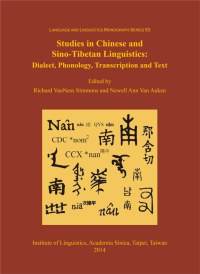
The Norman family warrants our special thanks for working with us in preparing Jerry Norman’s paper for this publication, and for their continued support, even as they were grieving the loss of their husband and father. Jing Coblin kindly provided the photograph of her husband, which appears as the frontispiece, and gave us warm, enthusiastic, and helpful encouragement from the outset. Russ Ganim provided helpful advice as we began this project, and Eden Lunde assisted with numerous proof-reading tasks. Zhāng Yànhóng assisted with translations of a number of abstracts. Matthias Richter, Brandon Dotson, Steve Wadley, and Young Oh, together with a number of our contributors, provided help with the cover images, and Oliver Emery assisted with the cover design.
Finally and most importantly, we join with our contributors in thanking our honoree, W. South Coblin, for teaching us all so much, whether directly in the classroom and conversations, or indirectly through his research and publications, and for thereby inspiring the research contained in this volume.