Piano
Maria João Pires: Complete Solo Recordings 豆瓣
10.0 (5 个评分) Maria João Pires 类型: 古典
发布日期 2014年6月2日 出版发行: DG
Released to celebrate the 70th birthday of Maria João Pires , this 20CD edition contains all her solo recordings made for DG. The edition includes outstanding interpretations of Bach, Beethoven and Schubert as well as Mozart’s complete piano sonatas and Chopin’s Nocturnes. This is the first out of three editions dedicated to the work of Pires.
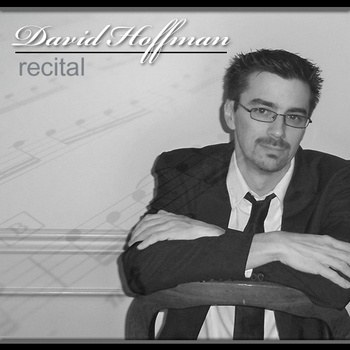
Recital 豆瓣
9.6 (11 个评分) David Hoffman 类型: 古典
发布日期 2011年1月5日 出版发行: Self-released
This album represents what is akin to a piano recital. As a piano student I never participated in this standard ritual (the recital). The pieces that I choose are not ones that are terribly difficult to master and typically serve as pieces that I play to "keep my fingers nimble". I felt compelled to try a project recording classical music, by the masters; such as Mozart, Bach and Beethoven. I learned much more from the process of recording these pieces than I had anticipated. With all that being said, here it is, for your listening pleasure, completely free of charge. Download, listen, relax, take a walk in the park with this music, or fall asleep to it. Whatever your application of these songs, I hope they offer something to you.
credits
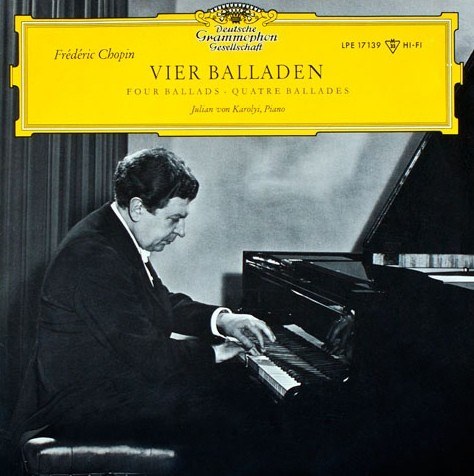
Vier Balladen 豆瓣
Julian von Károlyi 类型: 古典
发布日期 1958年7月1日 出版发行: Deutsche Grammophon
Credits
Composed By – Frédéric Chopin
Photography [~, München] – Rudolf Betz
Piano – Julian von Karolyi
Notes
Cover info:
Label name given as: Deutsche Grammophon Gesellschaft
Liner notes in German, English, French and Spanish, tracklist contains English and French translations
Printed in Germany · Imprimé en Allemagne · Impreso en Alemania 7/58
---
Centerlabels info:
Label design: Deutsche Grammophon Gesellschaft, tulip borders, bright yellow background
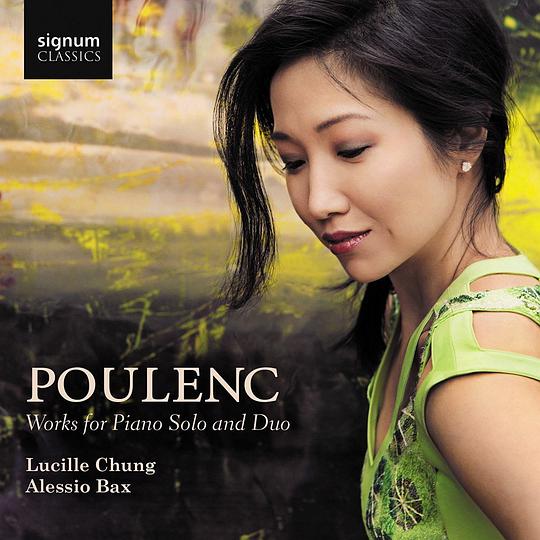
Poulenc: Works for Piano Solo & Duo 豆瓣
Lucille Chung (piano) / Alessio Bax (piano)
发布日期 2016年5月13日 出版发行: Signum Classics
Product Description
Poulenc was a skilled pianist, cultivating a style of playing characterised by colorfulness and clarity, possessing an ear for melody that distinguished him as France s finest song composer since Fauré. Canadian pianist Lucille Chung acclaimed for her 'stylish and refined performances' by Gramophone magazine, 'combining vigor and suppleness with natural eloquence and elegance' appears as a soloist on this new recording, performing Poulenc s Improvisations and Novelettes before being joined by her duo partner (and husband) Alessio Bax for L embarquement pour Cythère, the Sonata for Four Hands and Concerto for Two Pianos.
Review
'Lucille Chung s new Poulenc disc is doubly welcome. To begin with, Chung is a startlingly original pianist whose solo work, apart from discs of Scriabin and Ligeti, we ve heard too little of ... Chung captures the sense of a series of musical snapshots with the evanescent spontaneity of her playing. She is able to evoke the mercurial mood changes so characteristic of Poulenc with grace, consistently beautiful sound and an unerring sense of proportion. In succession, each seems more vivid than the last.' --Patrick Rucker Gramophone, August 2016
***** 'Lucille Chung proves a fantastic Poulenc advocate ... Alessio Bax, Chung s husband, joins her in the remaining works and the result is a marriage of shared executive excellence in the cheeky Sonata for Four Hands and optimistic L embarquement pour Cythère. In the composer s two-piano reduction of the Concerto for Two Pianos Chung and Bax tackle a sizeable work with aplomb, ferociously attacking the outer movements and achieving a delicious romance in the glorious central one. This is a release to savour' --Evan Dickerson Classical Ear, 17th August 2016
Prokofiev for Two 豆瓣
8.3 (6 个评分) 马尔塔·阿格里齐 Martha Argerich / Sergei Babayan 类型: 古典
发布日期 2018年3月23日 出版发行: Deutsche Grammophon
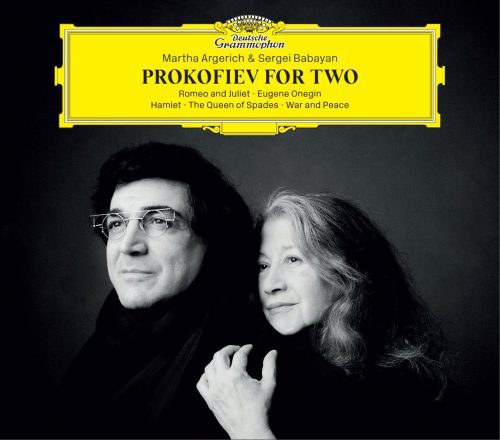
Pianists Martha Argerich and Sergei Babayan have recorded two selections from Prokofiev’s music for stage and screen in magnificent two-piano transcriptions by Babayan. Prokofiev for Two, set for release worldwide March 23 via Deutsche Grammophon/Universal Music Canada, the country’s leading music company, captures for posterity the sense of mutual inspiration felt by these kindred spirits, palpable in their live performances together. The upcoming album features Babayan’s twelve-movement transcription of numbers from the ballet Romeo and Juliet and his seven-movement suite transcribed from Prokofiev’s incidental music for Hamlet and Eugene Onegin, film score for The Queen of Spades and opera War and Peace.
Martha Argerich and Sergei Babayan first met in Brussels in 1991 when, on a whim, he looked her up in the phonebook and, to his own surprise, found her name and telephone number listed. His call from a phone box in the city started a strong friendship that led to numerous joint appearances in Europe and America. After one performance of Rachmaninov’s “Suite No.2” and other works for two pianos, Babayan told Argerich of his dream to transcribe pieces from Romeo and Juliet for their next duo date. “She was very inspired by the idea,” he recalls. “It was the greatest pleasure – and an honour – to create something that we would play together.” Babayan’s take on Prokofiev, coupled with a suite of rarities from the composer’s stage and film music, can be heard in Prokofiev for Two.
The freshly transcribed Prokofiev score received its premiere performance as part of the Martha Argerich Project at the 2013 Lugano Festival. Argerich and Babayan have since performed this work together with the revised Romeo and Juliet suite several times, most recently in concert at Stuttgart’s Liederhalle last November.
Martha Argerich is already renowned for her interpretations of Prokofiev’s music. The Argentine-born artist, hailed as one of the greatest pianists of all time, included the composer’s turbulent “Toccata” in her Deutsche Grammophon recital debut album, recorded in 1960. She reinforced her international reputation seven years later with a landmark recording for the yellow label of Prokofiev’s “Third Piano Concerto” with the Berliner Philharmoniker and Claudio Abbado. “I have loved Prokofiev ever since I can recall,” notes Argerich. “And people think he loves me too sometimes! I love the way Sergei [Babayan] plays Prokofiev and many other things. The first solo recital of his I heard was Bach’s Goldberg Variations and I was incredibly impressed by it. I very much liked his proposal that we should play his transcription of Romeo and Juliet and feel very honoured that he dedicated it to me.”
Babayan’s love for Prokofiev, like Argerich’s, is deeply rooted, dating back to his childhood in Armenia and student days at the Moscow Conservatoire. Having left the USSR for the first time in 1989, he settled in the U.S. Time and again, Babayan has paid tribute to Prokofiev, playing several of his piano concertos with Valery Gergiev including at the 2015 BBC Proms in a monumental concert with the London Symphony Orchestra featuring all five of the works.
His new Prokofiev transcriptions are both dedicated to Martha Argerich. “This project happened because of my love for Prokofiev, my love for Martha and my love for the ballet Romeo and Juliet,” reflects Babayan. The idea of transcribing Romeo and Juliet first arose decades ago while he was studying Prokofiev’s colourful instrumentation in close detail with an orchestra. Already aware of Argerich’s playing, he was further inspired after hearing a pirate recording of her 1981 Carnegie Hall performance of the “Ten Pieces Op.75” from Romeo and Juliet. “I listened and was immediately drawn to learn the cycle. But I felt that Prokofiev used chamber-like numbers for his selection of music for his transcription for solo piano. If you first became acquainted with the ballet through this piano score, you would never guess or understand the whole tragic, violent, and dark nature of the original work. Of course, the ballet contains lyrical, romantic music; music filled with humour and dance movement. But it also contains music for the “Death of Tybalt” – music of love and hate.”
Believing it would be impossible for music of such powerful emotion to be conveyed by two hands, and aware of Prokofiev’s own fondness for transcription, Babayan felt driven to exploit the full expressive force and tonal richness of two pianos. His created version contains what Martha Argerich, with a wry laugh, calls “difficult and demanding” technical and musical challenges. Both musicians, however, agree that transcription is “an act of love” and Babayan’s experience with Romeo and Juliet soon led him to explore some of the composer’s lesser-known works and create the second suite on this album. As he points out, this music will be new to most listeners. For example, only fragments of the film score for The Queen of Spades have ever been performed or recorded. He underlines its imaginative and innovative qualities, adding, “I’m sure if Prokofiev had lived longer he would have used the material for The Queen of Spades for a new movie, symphony, quartet or maybe even a piano duo. This music stayed on the shelf and it was my luck to hear it.”
Prokofiev for Two is driven by the passion and power of an ideal keyboard partnership. Martha Argerich considers playing in duo with Babayan to be “a thing of alchemy – a discovery”. For his part, Babayan says the experience of performing with Argerich is like joining a conversation with a divine being, one in which “you cannot be mundane or ordinary … Martha will somehow pull out the best from you.”
Das Wohltemperierte Clavier 豆瓣 苹果音乐 Spotify
Andras Schiff 类型: 古典 / 巴洛克时期 / 器乐演奏 / 钢琴
发布日期 2012年8月31日 出版发行: ECM New Series
András Schiff 在 ECM 录制了一系列伟大的作品,这也是他一生钻研伟大的钢琴文献所结出的硕果。他一直都热爱巴赫的作品,本张专辑是巴赫《平均律钢琴曲集》(Das wohltemperierte Klavier)的完整本。这也是他第二次录制这部作品,并为这部不朽的作品灌注了精巧、活力与变化。Schiff 找到了在现代钢琴上演奏巴赫的办法——演奏方式更强调对话性,在乐句上更加精雕细琢,同时在表现形式上更加简单,堪称大师手笔。
Beethoven: Piano Sonatas (No. 8 "Pathetique", No. 14 "Moonlight", No. 15 "Pastoral", No. 24) 豆瓣
Wilhelm Kempff
发布日期 1990年10月25日 出版发行: Polygram Records
L’adolescent, l’homme, le dieu” was Liszt’s description of Beethoven’s successive stages of development so patent in the 32 piano sonatas completed between 1795 and 1822, a series as remarkable for the composer’s constant quest for variety of pattern within the traditional sonata mould as his response to the challenge of the piano itself in crucial days of the instrument’s development in strength, compass and colour.
The Grande Sonate Pathetique, as its publisher first issued it, dates from 1798/99. Never before had Beethoven extracted more drama from C minor, always his most fateful key, than in the turbulent opening movement starting with an imposing Grave introduction twice recalled in the course of the sonata-form argument(like Clementi and Dussek he had already tried out a similar device in a sonata written at eleven). It is no surprise to learn from letters that already in the later 1790s he was secretly tormented by early symptoms of deafness. Assuagement comes in the idyllic, recurrent song melody of the Adagio cantabile in A flat, though tension mounts in two contrasting episodes. The finale is an urgent sonata-rondo back in the home key of C minor.
Composed in 1801, during an ill-starred romance with its youthful dedicatee, the Countess Giuleatta Guicciardi, the C sharp minor Sonata testifies to Beethoven”s tireless pursuit of formal adventure: like its predecessor in E flat it carries the subtitle “quasi una fantasia”. His boldest stroke was in opening with an Adagio sostenuto, music sufficiently hypnotic in its calm to remind the poet-critic Rellstab of moonlight on Lake Lucerne- hence the nickname appended after Beethoven’s death. For the Alegretto, a gracious old-style minuet and trio following without sharp break, Beethoven slips enharmonically into D flat major. The finale in the home key is a passionately disturbed Presto agitato in sonata form.
Following hard on the heels of the “Moonlight” in the same year of 1801, the D major Sonata reverts to a traditional four-movement sequence. The nickname “Pastoral” came frome the publisher Cranz. But the music exudes enough of the relaxationg and simple joy Beethoven always found in the country(openly confessed in the Sixth Symphony) to make it easy to believe Czerny’s contention that the sonata was one of the composer’s favourites. Repeated low Ds, like a rustic drone, support the opening tune of the sonata-form Allegro. The lilting main theme of the sonata-rondo finale, again with a drone-like accompaniment, is still more redolent of the village green. Though the D minor-major Andante, with its regular, march-like tread, is tinged with regret, the Scherzo is one of the composer’s most playful.
Beethoven was in his 40th year when composing the F sharp major Sonata in 1809, after four years away from the genre; in total contrast to its stormy F minor predecessor, the “Appassionata”, this gracious work in only two movements was dedicated to the Countess Therese von Brunsvik, who though no longer accepted as his legendary “immortal beloved”, was one of the few closest to his heart whose character approached his own exalted ideals of womanhood. With the unpredictability of genius Beethoven rejects heart-searching, after only the briefest Adagio cantabile introduction, to write a radiantly lyrical Allegro non troppo in concisely expressed sonata form. In the scherzando-like concluding Allegro vivace, also in(for him) the unusual key of F sharp major, he springs constant surprises of tonality, register and dynamics.