Pierre Boulez — 艺术家 (191)
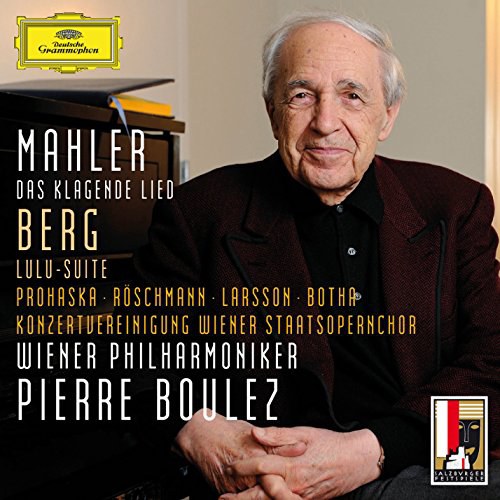
Mahler: Das klagende Lied / Berg: Lulu-Suite [音乐] 豆瓣
Dorothea Röschmann / Anna Prohaska 类型: 古典
发布日期 2013-03-04 出版发行: Decca (UMO)
Berg:
Lulu-Suite (Five Symphonic Pieces) for soprano and orchestra
Anna Prohaska (soprano)

Mahler:
Das klagende Lied
Dorothea Röschmann (soprano), Anna Larsson (contralto), Johan Botha (tenor)
Konzertvereinigung Wiener Staatsopernchor
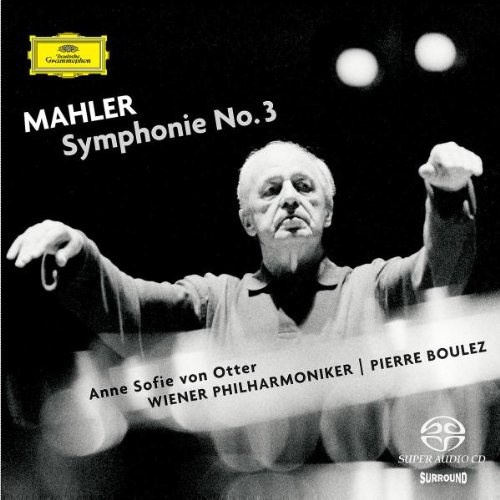
Bruckner: Symphony 8, Pierre Boulez/Vienna Philharmonic Orchestra [音乐] 豆瓣
发布日期 2000-10-16 出版发行: Deutsche Grammophon
This is an exceptional Bruckner Eighth, make no mistake. Here’s why. Pierre Boulez does all of the things that a great Bruckner performance requires. First, he never rushes. Second, he knows that if the tempo’s going to change at a climax, it should only get broader (try the slow movement or the finale’s coda). Third, he reserves major gear shifts for important structural points, as for example the move from the tempo of the opening theme to a more flowing speed for the second subject. Fourth, he lets the brass and timpani really play out when necessary, and fifth, he doesn’t make willful dynamic adjustments even when Bruckner lets the music go on at a single volume level for unusually long periods (as at that strange, quiet musical “plateau” just before the climax of the first movement’s development section, or long passages in both the adagio and finale). He also uses the Haas Edition, which isn’t a big deal with me, but which I prefer simply because it includes a little more music than Nowak. Finally, Deutsche Grammophon has captured the whole affair in clear, close, natural sonics. Yes, the acoustic of the Austrian monastery church of St. Florian (Bruckner’s own “home away from home”; he’s buried in a crypt under the organ that bears his name) absorbs some of the high frequencies and makes the timpani a bit boomy, but this is a real “Bruckner” sound: big, reverberant, the horns less forward though not less powerful than in many other VPO productions, the whole capped by brilliant trumpets that add an almost Baroque splendor to the aural palette. Recorded live four years ago at the 1996 International Bruckner Festival, this performance is an event well worth waiting for, one of the best things Boulez has ever done for any composer. And that’s saying a lot. [6/14/2000]
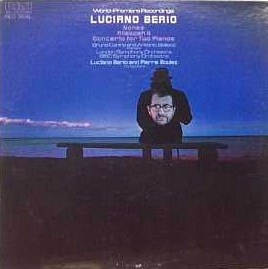
Berio: Nones; Allelujah II; Concerto for two pianos [音乐] 豆瓣
London Symphony Orchestra / Luciano Berio
发布日期 1976-06-17 出版发行: RCA Red Seal
BERIO. Concerto for two pianos. Bruno Canino, Antonio Ballista (pianos), London Symphony Orchestra conducted by Luciano Berio. Nones. London Symphony Orchestra conducted by Luciano Berio. Allelujah II. BBC Symphony Orchestra conducted by Pierre Boulez and Luciano Serb. RCA Red Seal RL11674 (349).
The Double Piano Concerto is the point here. It was composed for New York Lincoln Center in 1972-3, designed for the marvellous pianists who play it here, as they did at the London premiere. The piano parts, not only two but three (a discrete orchestral pianist fills out the texture now and then—the violins are divided into three as well), are percussive rather than melodious, the melodies given to orchestra (flute, violin, and clarinet are all favoured in this respect). The single movement begins sensuously and lazily, with occasional outbursts, like a sunbather obliged sometimes to swat a persistent insect. The melodies flow, the pianos splash (efficiently according to the score which I hope Universal Edition will soon make commercially available). Tension heightens, pace accelerates, orchestral density increases. Gradually the excitement dies away, and the pianos sing Amen more or less in G major.
It is perhaps more entertaining than profound by intention, certainly enjoyable and worth repeated listening. The busy solo parts are admirably played and recorded; some elaborate tutti textures sound imperfectly balanced, according to the score, though more vivid than I remember of the London premiCre. Tape noise is quite high.
Side I consists of two 1950s pieces, quite early Berm. Nones by now seems an academic period piece, a sort of instrumental Passion (Nones is the ninth hour at which Jesus yielded up the ghost), cool but imagined and scored with characteristic imagination. Allelujah II, an expansion and reworking of the eponymous No. 1, makes a more colourful and lively effect. Both works are played with apparently loving labour; the acoustical complexities of Allelujah II (they involved the loan of Boulez assistance by CBS) sound really well. Nevertheless it is for the Double Piano Concerto that the record is principally recommendable, and strongly at that. W.S.M.
from the Gramophone, August 1977, p. 34.
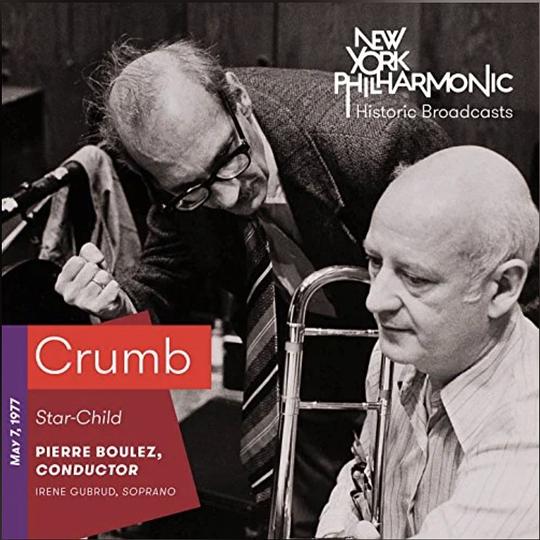
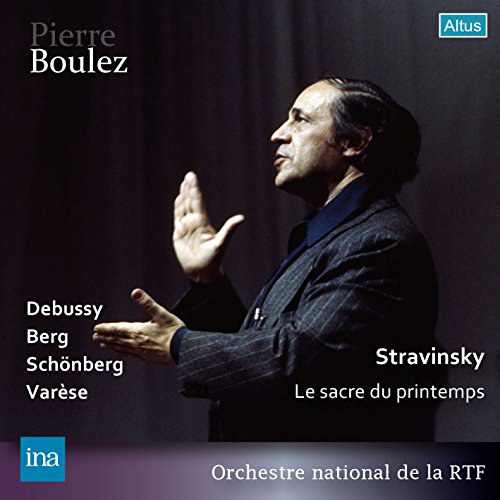
Composer, Conductor, Enigma [音乐] 豆瓣
Pierre Boulez 类型: 古典
发布日期 2022-06-17 出版发行: Cherry Red
Description
Additional information
Tracklist
• Four-disc box set presentation is an anthology of Pierre Boulez’s early compositions; complex, radically new and quite ferociously uncompromising.
• Such fearless, notoriously demanding works as the second ‘Piano Sonata’ may be heard alongside the gorgeous ultra-modernist exoticism of ‘Le Marteau sans maître’ and ‘Pli selon pli’.
• These breathtakingly ambitious works are complemented by the first recordings of Boulez as conductor, made at the Domaine musical, a society he formed in Paris during the mid- ‘50s to provide a platform both for modernist pieces by the likes of Webern, Messiaen and Stockhausen and works which had played a vital role in the evolution of music by such composers as Debussy and Bartok.
As a conductor Boulez flew high and fast, engaged as Music Director of the New York Philharmonic and as chief conductor of the BBC Symphony Orchestra by William Glock, Controller of Music at the corporation, and fervent new music enthusiast: “Boulez’s ear was fabulous. It was as though he was attached by a hundred strings to every member of the orchestra.”
“Pierre Boulez was arguably the single dominant figure of the classical musical world through the second half of the 20th century and beyond. Without his compositions, his legacy of recordings as a conductor, his writings on music and his administrative skill and drive, the musical scene today would be of a quite different order.” Roger Nichols
“Boulez exemplified the ethos of his generation. Cool, brutal, elegant, fiery, he established a kind of International Style in music, and propagated it in polemical writings and through institutional networks. As a conductor, he was an exacting, absorbing interpreter of the advanced styles he favoured.” Alex Ross: The Magus – Pierre Boulez’s Fiery Career.
Frank Zappa of The Mothers Of Invention bought his first Boulez album in twelfth grade. He is listed as an influence on the cover of ‘Freak Out!’ (1966) under the heading “These People Have Contributed Materially In Many Ways To Make Our Music What It Is. Please Do Not Hold It Against Them.”