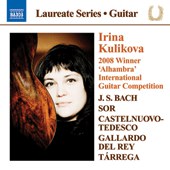
Irina Kulikova: Guitar Recital
Johann Sebastian Bach (1685–1750): Cello Suite No. 1, BWV 1007 (arr. Irina Kulikova)
Fernando Sor (1778–1839): Fantaisie, Op. 30
Mario Castelnuovo-Tedesco (1895–1968): Guitar Sonata ‘Omaggio a Boccherini’
José María Gallardo Del Rey (b. 1961): California Suite
Francisco Tárrega (1852–1909): Recuerdos de la Alhambra
The guitar is ideal for lyrical romanticism, and always has been in its long history. But its clarity and fluency of line also provide scope for contrapuntal complexity characterized in the baroque era by the master works of J.S. Bach. The intimate voice of the guitar lends itself to every epoch and within this selection we move from the eighteenth century to the Napoleonic period, and then to Francisco Tárrega, the high priest of guitar expressiveness, and, in the twentieth century, to the profoundly Italian inspiration of Castelnuovo-Tedesco. Also represented here are the elegant musical statements of a modern virtuoso, José María Gallardo del Rey, a contemporary guitarist/ composer. The richness of textures to be found throughout is truly remarkable, proving once again that a guitar is appropriate for all seasons and for so many varied moods and emotions.
J.S. Bach composed the Six Suites for Violoncello Solo, BWV 1007–1012 while in the service of the Margrave of Brandenburg at Cöthen between 1717 and 1723. The great Catalan cellist, Pablo Casals, described how from these suites ‘a whole radiance of space and poetry pours forth…They are the essence of Bach and Bach is the essence of music’. The Prelude is particularly well suited to the guitar in as much as it is within the tradition of the broken-chord preludes familiar in Italian lute music. This was first performed on the guitar in a special arrangement (never published) by Segovia and, ever since, guitarists have found it one of the most delightful of all Bach transcriptions. In contrast, the Allemande is a lilting exercise in scale passages. The dance itself is of German origin, its four beats in a bar giving it stability, ease and fluency. The Courante is a bubbling, effervescent stream, from the French verb ‘to run’, and is characterized here by wide leaps in the melody and catchy, insistent rhythms. The Sarabande, the emotional centre of the baroque suite, is very close to the original Spanish dance and here the mood is of reflection with a hint of melancholy. Such feelings are partially dispersed by the following pair of Menuets, each of which begins with a version of the four chord formulae at the opening of the Prelude. The form itself of this movement is very physical and springy, bringing us back, as it were, to simple pleasures and releasing us from the introspective gravity of the Sarabande. Finally the Gigue generates excitement, vigour and zest with a foot-tapping rhythm, its six-eight pulse recalling the English jig from which the dance is probably descended.
Fernando Sor performed his music on a guitar that was slightly smaller in structure than the instrument as we know it today. Yet his compositions capture the atmosphere of the guitar as a ‘miniature orchestra’. Sor emulated the great composers of his era by writing sonatas, fantasias, and sets of variations to increase the scope of the guitar. He also composed many studies, for all levels of ability, and wrote an influential Guitar Method. Though Spanish by birth, he emigrated to France to the stimulating musical environment of Paris. He also travelled extensively as a concert artist, giving recitals in England, Poland and Russia. Fantaisie Op. 30, dedicated to Sor’s friend, the great guitarist Dionisio Aguado, and first published in 1828, begins with a short introduction which passes through a number of ingenious modulations, from E minor to C major and back again, at one point putting the melody in the bass against a treble accompaniment. The genial and lilting theme is followed by three concise variations, the third of these, Lentement, in two-four time, being the most poignant and reflective. The fourth variation is, as Julian Bream described it, ‘dramatically extended with its theme recurring in its major (a fragment) and minor forms, before the final movement, a rambunctious affair in free rondo form’.
In 1932 Andrés Segovia travelled by car with Manuel de Falla from Spain to the International Festival of Music in Venice. At the Festival Segovia was introduced to Mario Castelnuovo-Tedesco, the eminent Italian composer from Florence, who became fascinated by the guitar and decided to explore its musical possibilities. Between 1932 and his death in 1968, Castelnuovo-Tedesco wrote over a hundred works for the instrument, including sets of variations, concertos, duos, chamber music with guitar, impressionistic pieces of various kinds, and, among his finest solo compositions, Sonata, Op. 77 ‘Omaggio a Boccherini’, written at Segovia’s request in 1934 for ‘a Sonata in four movements’. Castelnuovo-Tedesco commented: ‘The Sonata is in four movements, but it is mainly in the first movement, Allegro con spirito, and in the Minuetto, that one can find the graciousness which was so characteristic of Boccherini. The Andantino, quasi canzone, on the other hand, refers to Boccherini’s ‘romantic’ mood, while the Finale, Vivo ed energico, highlights the bravura elements always present in his music’.
José María Gallardo del Rey, born in Seville, Spain, studied with the distinguished guitarist, José Tomás, and attended master-classes by Segovia, Regino Sáinz de la Maza, and Rodrigo de Zayas. He has won a number of international competitions, held important teaching posts at the Seville Conservatoire, and is now one of the leading international recitalists with a number of very successful recordings to his name. Gallardo del Rey has said about his California Suite: This is my first composition, written in Madrid during 1985, and dedicated to my dear friend, Joseph Mastroianni, living in California, and so that is the reason for its title. The piece was greatly inspired by J.S. Bach and Rachmaninov, two of my favourite composers at that time. Written in four movements, this is a musical tribute to the baroque suite but with some additional Broadway details, especially in the harmonies and in the last movement, Vals. The first performance was given by the composer in 1985 in Madrid.
Francisco Tárrega was a leading personality of immense significance in the guitar’s development in terms of technical innovations, compositions, and the art of arrangement. His advocacy of new concepts of guitar construction embodied in the work of Antonio de Torres (1817–1892), the great Spanish luthier, has proved influential right up to the present time. Working with the Torres type of instrument (with its enhanced tonal qualities, fan strutting and a 650 millimetre string length), Tárrega established teaching methods including the most practical way of holding the guitar (using a footstool to raise the left leg), principles of left and right hand techniques, and studies to develop a player’s skills. Furthermore, Tárrega composed some remarkable music for the instrument, meticulously indicating the precise placing of notes on the fingerboard to produce the most vibrant effects. In many exquisite miniatures, often influenced by Chopin, he established a Spanish romantic voice for the guitar which has enchanted public and players ever since. Undoubtedly the most famous of his compositions is Recuerdos de la Alhambra, celebrating some time he spent in the Moorish palace, the Alhambra, in Granada, one of the world’s finest historical monuments. This superb example of Tárrega’s wistful creation of atmosphere is a thin sliver of delightful melody, tastefully harmonized, concise but utterly memorable. By exploiting the ‘tremolo’ technique, the guitarist’s only device by which an unbroken legato line can be simulated, Tárrega demonstrates the poet’s adage that ‘the song of the piano is a discourse, the song of the harp is an elegy, but the song of the guitar is a song’.
Graham Wade