ALBERT CAMUS — 作者 (98)
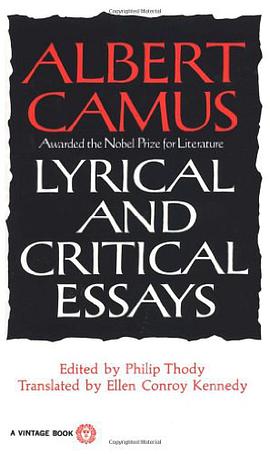
Lyrical and Critical Essays [图书] 豆瓣
作者: Albert Camus 译者: Ellen Conroy Kennedy 出版社: Vintage 1970 - 9
Review
Lyrical And Critical Essays
"The literary output of Albert Camus was exceptionally concentrated and well organized, so that each part of it throws light on the other parts.... Here now, for the first time in a complete English translation, we have Camus' three little volumes of essays, plus a selection of his critical comments on literature and on his own place in it. As might be expected, the main interest of these writings is that they illuminate new facets of his usual subject matter."
-- John Weightman, The New York Times Book Review
"The work of Albert Camus began to achieve international recognition after World War II, and from then until his death in 1960 no author was a greater articulator of the general reevaluation of human action that took place in the best literature of this period... because those works are so intense, so occupied with the themes of a civilization, it is good to have small, sometimes rough pieces which show a great writer close to the stuff of experience he would later refine and set into parables for an age. For it was his ability to stay near the plain, uncelebrated habits of life that gave Camus' art its peculiar strength and his thought its hard humanity."
-- Jack Richardson, Book World
"Some of the pieces have been translated individually before, but several of the best have not, and the complete sequence forms what is in effect a new, single work for American readers that stands among his very finest."
-- Donald Lazere, The Nation
Create Dangerously [图书] 豆瓣
作者: Albert Camus 出版社: Penguin Classics 2018 - 2
'To create today is to create dangerously'
Camus argues passionately that the artist has a responsibility to challenge, provoke and speak up for those who cannot in this powerful speech, accompanied here by two others.
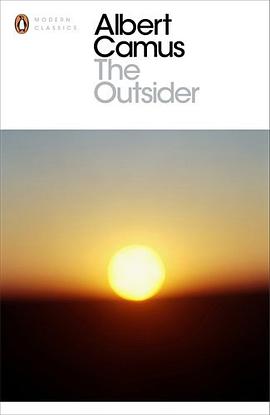
The Outsider [图书] 豆瓣
L'Étranger
8.8 (5 个评分) 作者: Albert Camus 译者: Sandra Smith 出版社: Penguin Classics 2013 - 10
'My mother died today. Or maybe yesterday, I don't know.' In The Outsider (1942), his classic existentialist novel, Camus explores the alienation of an individual who refuses to conform to social norms. Meursault, his anti-hero, will not lie. When his mother dies, he refuses to show his emotions simply to satisfy the expectations of others. And when he commits a random act of violence on a sun-drenched beach near Algiers, his lack of remorse compounds his guilt in the eyes of society and the law. Yet he is as much a victim as a criminal. Albert Camus' portrayal of a man confronting the absurd, and revolting against the injustice of society, depicts the paradox of man's joy in life when faced with the 'tender indifference' of the world. Sandra Smith's translation, based on close listening to a recording of Camus reading his work aloud on French radio in 1954, sensitively renders the subtleties and dream-like atmosphere of L'Étranger. Albert Camus (1913-1960), French novelist, essayist and playwright, is one of the most influential thinkers of the 20th century. His most famous works include The Myth of Sisyphus (1942), The Plague (1947), The Just (1949), The Rebel (1951) and The Fall (1956). He was awarded the Nobel Prize for Literature in 1957, and his last novel, The First Man, unfinished at the time of his death, appeared in print for the first time in 1994, and was published in English soon after by Hamish Hamilton. Sandra Smith was born and raised in New York City and is a Fellow of Robinson College, University of Cambridge, where she teaches French Literature and Language. She has won the French American Foundation Florence Gould Foundation Translation Prize, as well as the PEN Book-of-the-Month Club Translation Prize.
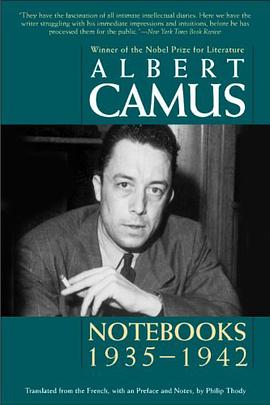
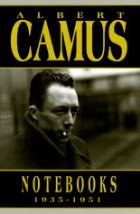
Notebooks, 1935-1942 [图书] 豆瓣
作者: Albert Camus 译者: Philip Thody 出版社: Ivan R. Dee, Publisher 2010 - 9
From 1935 until his death, Albert Camus kept a series of notebooks to sketch out ideas for future works, record snatches of conversations and excerpts from books he was reading, and jot down his reflections on death and the horror of war, his feelings about women and loneliness and art, and his appreciations for the Algerian sun and sea. These three volumes, now available together for the first time in paperback, include all entries made from the time when Camus was still completely unknown in Europe, until he was killed in an automobile accident in 1960, at the height of his creative powers. In 1957 he had been awarded the Nobel Prize for Literature. A spiritual and intellectual autobiography, Camus' Notebooks are invariably more concerned with what he felt than with what he did. It is intriguing for the reader to watch him seize and develop certain themes and ideas, discard others that at first seemed promising, and explore different types of experience. Although the Notebooks may have served Camus as a practice ground, the prose is of superior quality, which makes a short spontaneous vignette or a moment of sensuous beauty quickly captured on the page a small work of art. Here is a record of one of the most unusual minds of our time.
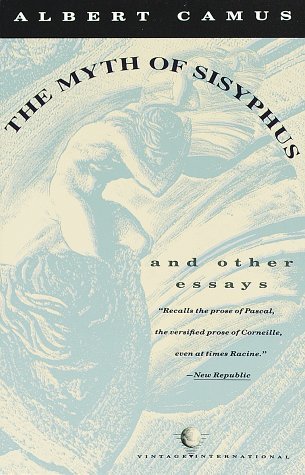
The Myth of Sisyphus and Other Essays [图书] Goodreads
Le Mythe de Sisyphe
作者: Albert Camus 译者: Justin O'Brien 出版社: Vintage International 1991 - 5
One of the most influential works of this century, this is a crucial exposition of existentialist thought. Influenced by works such as Don Juan, and the novels of Kafka, these essays begin with a meditation on suicide: the question of living or not living in an absurd universe devoid of order or meaning. With lyric eloquence, Camus posits a way out of despair, reaffirming the value of personal existence, and the possibility of life lived with dignity and authenticity.
鼠疫 [图书] Goodreads
La Peste
作者: Albert Camus / 阿爾貝.卡繆 译者: 顏湘如 出版社: 麥田 2012 - 4
◆《異鄉人》作者/存在主義大師/諾貝爾文學獎得主/二十世紀法國文豪 卡繆
在遍地鼠屍、鼠血橫流、屍臭沖天的疫病封鎖現場
直視人類恐懼、深入存在之輕與生命之重的小說創作
「法文"La Peste"的現代意義首先是『鼠疫』,『鼠疫』作為書名更能表達這部作品的神髓。」--淡江大學法文系教授 吳錫德
這些散布在歷史當中的一億具屍體,不過就是想像中的一縷煙罷了。
然而,在那縷沒有重量的輕煙裡,卻閃現著為生存而奮戰最根本的理由!
吱吱吱……吱吱吱……
一天,李厄在樓梯平台上踢到一隻死老鼠。當晚,李厄上樓回家,忽然看見走廊角落竄出一隻大老鼠,步伐有些不穩,隨後在原地打轉,最後倒地從微張的嘴吐出血來。
吱吱吱……吱吱吱……
就從這天開始,各處冒出猝死的老鼠屍體,緊接著是鄰人紛紛暴斃。政府只得將發生疫情的奧蘭市全城封鎖,連信件都不得流通。來自外地的旅人被困在這座不屬於自己的城市,而當地市民與外地親人的重逢也顯得遙遙無期。
吱吱吱……吱吱吱……
這是高八度的喪鐘鐘聲,還是喚醒人心之善的低喃?在孤絕禁錮而束手無策的絕望情境中,你是否仍願為幸福做出最後一絲努力?
【名家推薦】
◎淡江大學法文系教授 吳Ÿ
思索斷頭台 [图书] 豆瓣 谷歌图书
Reflexions sur la guillotine
作者: Albert Camus / 張寧 译者: 石武耕 出版社: 無境文化 2012 - 3
「我對父親的事情所知不多,其中一件就是:這是他生平第一次想去看處決。他天還沒亮就起床,前往本市另一頭的刑場,此時刑場周圍已擠滿人潮。他從不曾告訴別人,他那天早上看見了些什麼。我母親只說,父親飛奔回家時,神色慌亂、也不答話,就在床上躺了下來;不一會兒,就翻過身,嘔吐了起來。他剛發現了,在漂亮的說辭底下,被掩蓋的那關於死刑的真相。這時他還能想到的,已不是那些遇害的孩童,反而只剩那具剛被人扔上斷頭台斬斷脖子的、仍在抽慉的屍首……」
卡繆是記者、作家、哲學家、諾貝爾獎得主……。.他更是一名鬥士,在其過短的一生中為理念而奮戰不懈,一個名副其實的公共知識分子 。他於1957年發表的《思索斷頭台》已經是一篇經典 :除了闡明死刑不是有效抑制犯罪的方法,並且比傳統社會的以牙還牙還要殘酷野蠻,尤有甚者,死刑還可能是讓國家、或者讓國家的掌權者將因其怠惰失職而養成的罪犯「毀屍滅跡」的手段。如果國家的暴力,託詞於一些理論與現實上都不能成立的理由,只是為了保護權位而殺戮,那麼民主,就必須是要對抗這樣的國家!
本書並收錄日內瓦大學張寧教授的「考論死刑」。希望能幫助讀者對於死刑有更全面、深入的了解;畢竟認識死刑、思索死刑之後,我們才能真正地支持或反對死刑。
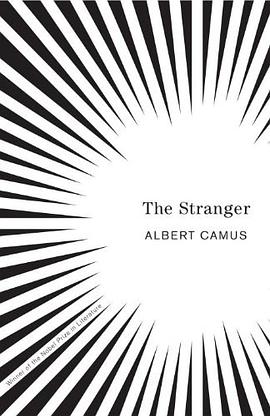
The Stranger [图书] 豆瓣
作者: Albert Camus 译者: Matthew Ward 出版社: Perfection Learning 1989 - 3
Through the story of an ordinary man unwittingly drawn into a senseless murder on an Algerian beach, Camus explored what he termed andquot; the nakedness of man faced with the absurd.andquot; First published in 1946; now in a new translation by Matthew Ward.
Caligula suivi de Le malentendu [图书] 豆瓣
作者: Albert Camus 出版社: Bantam Books 1972 - 3
Avec Le Malentendu et Caligula, Albert Camus fait appel à la technique du théâtre pour préciser une pensée dont l'Etranger et le Mythe de Sisyphe ? sous les asp ects du roman et de l'essai ? avaient marqué les points de départ. Est-ce à dire que l'on doive considérer le théâtre d'Albert Camus comme un « théâtre philosophique »? Non ? si l'on veut continuer à désigner ainsi cette forme périmée de l'art dramatique où l'action s'alanguissait sous le poids des théories. Rien n'est moins « pièce à thèse » que le Malentendu, qui, se plaçant seulement sur le plan tragique, répugne à toute théorie. Rien n est plus « dramatique » que Caligula, qui semble n'emprunter ses prestiges qu'à l'histoire. Mais la pensée est en même temps action et, à cet égard, ces pièces forment un théâtre de l'impossible. Grâce à une situation (le Malentendu) ou un personnage (Caligula) impossible, elles tentent de donner vie aux conflits apparemment insolubles que toute pensée active doit d'abord traverser avant de parvenir aux seules solutions valables. Ce théâtre laisse entendre par exemple que chacun porte en lui une part d'illusions et de malentendu qui est destinée à être tuée. Simplement, ce sacrifice libère peut-être une autre part de 1’individu, la meilleure, qui est celle de la révolte et de la liberté. Mais de quelle liberté s'agit-il? Caligula, obsédé d'impossible, tente d'exercer une certaine liberté dont il dit simplement pour finir « qu'elle n'est pas bonne ». C'est Pourquoi l'univers se dépeuple autour de lui et la scène se vide jusqu'à ce qu'il meure lui-même. On ne peut pas être libre contre les autres hommes. Mais comment peut?on être libre? Cela n'est pas encore dit. Source : Le Livre de Poche, LGF (Descriptif issu de : Livrenpoche) Plus Moins
Noces suivi de L'Été [图书] 豆瓣
作者: Albert Camus 出版社: Gallimard 1972 - 1
Quoi qu'en disent les bibliographies, Noces ou l'été ne peut être considéré comme un essai. Aucun des deux ouvrages n'offre une thèse forte ou une argumentation rigoureuse. Bien au contraire, les deux ouvrages sont des recueils de tentatives littéraires de Camus. Pas des brouillons ou des ouvrages inachevés. Simplement des textes courts qui trouvent en eux leur propre cohérence nous emmène généralement en Algérie, pays de sable et de poussière où les villes ont encore l'audace de tourner le dos à la mer qui les borde et de leur préférer les pierres du désert.
Dans ces deux recueils, Camus se livre à des évocations lyriques de son pays natal auxquels ils opposent la froideur de la vie européenne, contrainte par le Passé et l'Histoire. Toutefois, il lui arrive de tomber dans l'essai promotionnel, certains se veulent plaidoyer, tract publicitaire, brochure touristique et Camus, malgré son talent d'écriture, se laisse aller à avancer l'argument puéril que seules les grandes âmes et les beaux tempéraments peuvent jouir du voyage en Algérie.
Les meilleurs essais dans l'été forment tout au plus des balades agréables et critiques dans les grandes villes algériennes, Alger et Oran surtout dont il décrit l'aspect poussiéreux, le dédale de ruelles qui détourne la ville de la mer et le travail sysiphéen des hommes qui déplacent les cailloux des jetées dans la mer.
Mais jamais dans ces deux recueils qui se répondent parfaitement et se font parfois écho quand on s'approche de Tipasa, jamais Camus ne parvient à transcrire ces noce avec le paysage algérien, avec la vie algérienne qu'ils annoncent dans le titre du premier recueil. Pour le lecteur même plein de bonne volonté, ces essais restent les descriptions des paysages et des villes algériennes dans l'été qui les révèlent.
The Stranger [图书] 豆瓣
作者: Camus, Albert 译者: Ward, Matthew 1989 - 3
In the story of an ordinary man who unwittingly gets drawn into a senseless murder on a sun-drenched Algerian beach, Camus was exploring what he termed "the nakedness of man faced with the absurd". Now in a new American translation, the classic has been given new life for generations to come.
Discours de Suède [图书] 豆瓣
作者: Albert Camus 出版社: Gallimard 1997 - 2
On aura peut-être été un peu surpris de voir dans ces discours l'accent porté par Camus sur la défense de l'art et la liberté de l'artiste - en même temps que sur la solidarité qui s'impose à lui. Cela faisait certes partie de ce que lui dictaient les circonstances et le milieu où il devait les prononcer, mais il est certain que Camus se sentait accablé par une situation où, selon ses propres paroles, "le silence même prend un sens redoutable. À partir du moment où l'abstention elle-même est considérée comme un choix, puni ou loué comme tel, l'artiste, qu'il le veuille ou non, est embarqué. Embarqué me paraît ici plus juste qu'engagé." Et malgré une certaine éloquence - qu'on lui reprochait également - il se sentait profondément concerné et douloureusement atteint par un conflit qui le touchait jusque dans sa chair et dans ses affections les plus enracinées.
Carl Gustav Bjurström.